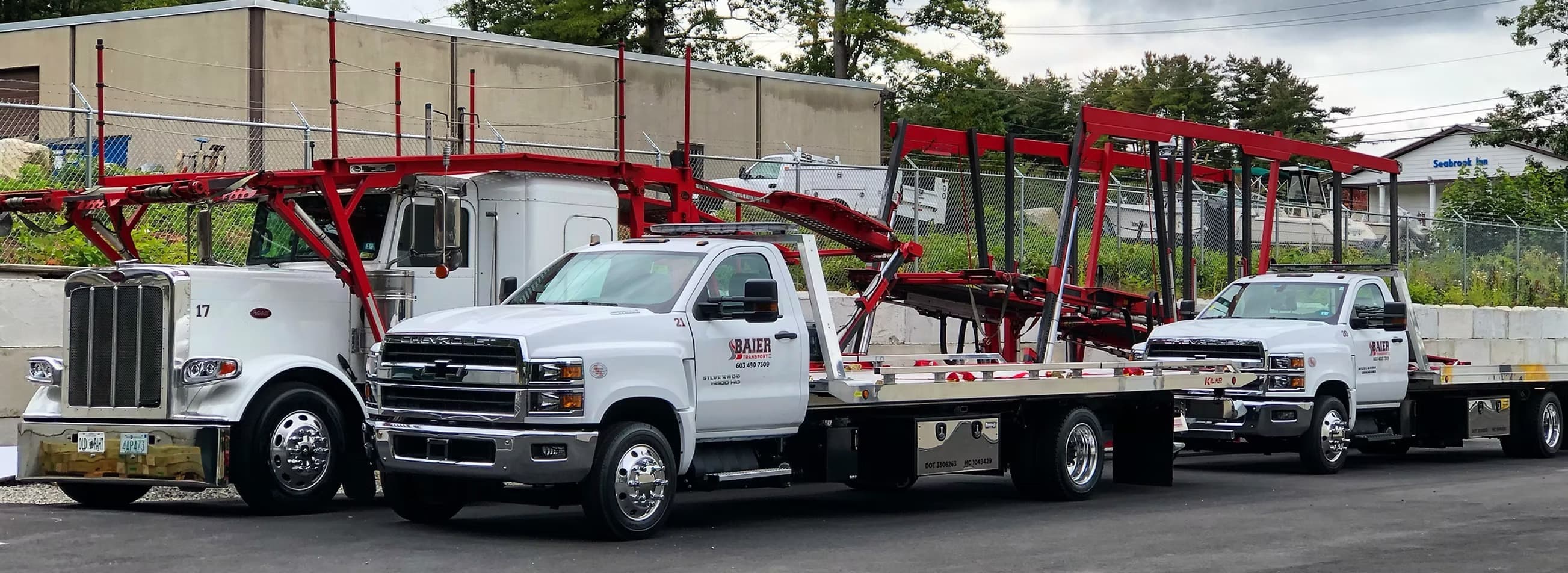
An auto transport carrier is a trucking company that owns the equipment and employs the drivers who physically move your vehicle. Carriers hold FMCSA motor carrier authority, carry their own cargo insurance, and are the party legally responsible for your car from pickup to delivery. Unlike a broker, a carrier does the work itself.
That distinction is the whole ballgame in car shipping. When something goes right or wrong, the carrier is the company that was actually there. A carrier runs assets: trucks, trailers, drivers, and a dispatch operation that decides where they go. A typical over-the-road car hauler is a tractor pulling an open multi-level trailer that holds 7 to 10 vehicles. Enclosed rigs usually carry 2 to 6.
Dispatch builds a load by filling that trailer along a route. That is why pickup windows exist instead of appointment times: a driver heading from New England to Florida is stacking eight cars across a few hundred miles of collection stops before the linehaul run south. Add one car in the wrong direction and the whole load loses a day. Carriers get freight two ways. They book it directly from customers and dealers, or they take it off a load board posted by brokers. Most small carriers live almost entirely on brokered freight. A carrier with its own booked demand on a repeating lane does not have to.
Legally, a carrier must have active motor carrier operating authority, a USDOT number, an MC number, minimum liability coverage, and its own cargo insurance policy covering the vehicles on the trailer. All of that is public record and takes about two minutes to check. Typical Northeast-to-Florida transit is 2 to 5 days once the vehicle is loaded, depending on how many stops are on the run and where you sit in the delivery sequence.
Booking with a carrier collapses the chain of responsibility to one company. The people quoting you are the people scheduling the truck, and the truck is theirs. That has practical consequences. A carrier can commit to a real pickup window because it controls the equipment. The price does not need to be renegotiated later to attract a driver, because no driver has to be attracted. Damage claims go to the company you signed a contract with, on a policy you can request in advance. The honest tradeoff: a carrier only serves the lanes it actually runs. If your route falls outside their operating area, a good carrier will tell you so and point you to a broker or a partner. That is not a weakness — it is the reason their lanes work.
Customers assume that any company with "transport" or "carrier" in its name owns trucks. Many do not. The marketing language to watch for is "our carrier network," "vetted carriers," and "preferred partners" — all of which mean somebody else drives. The fix takes two minutes. Get the company's MC number, look it up in the FMCSA SAFER system, and read the authority type and the power-unit count. A real carrier shows a fleet size and driver count. A broker shows zeros. Our guide on finding a real carrier walks through the lookup screen by screen. Baier Transport LLC owns its trucks and employs its drivers. We have moved 251,015+ vehicles, hold a BBB A+ rating, and run the Northeast-to-Florida corridor out of Seabrook, New Hampshire — plus ADESA Boston and Manheim New England auction lanes for our dealer clients.