B2B Auto Transport
B2B Auto Transport for Dealers, Auctions & Fleets
Baier Transport is the carrier dealerships and auction houses trust for high-volume vehicle logistics. Competitive fleet pricing, dedicated dispatch, and a 98% on-time rate that keeps your lots stocked and your customers happy.
Or call (603) 490-7309Built for the Automotive Industry
Dedicated transport solutions for every segment of the auto business.
Dealership Groups
Daily and weekly scheduled runs between your lots. Dealer trades, inventory transfers, and customer deliveries across New England and the East Coast.
Auction Coverage
Reliable pickup and delivery from ADESA, Manheim, Southern Auto Auction, and independent auction houses. Same-week turnaround on most routes.
Brokerages
Dependable carrier partnerships for transport brokers. Consistent capacity, competitive rates, and the professionalism your customers expect.
Manufacturers & Upfitters
Port-to-dealer, factory-to-upfitter, and upfitter-to-dealer transport. We handle high-value new inventory with documented condition reports.
How It Works for Dealers
Request Corporate Pricing
Share your typical routes, volume, and vehicle mix. We build a custom rate sheet within 24 hours.
Schedule & Dispatch
Submit orders through your preferred channel: phone, email, or our dispatch portal. We confirm pickup windows same-day.
Track & Confirm
Receive real-time status updates from pickup through delivery. Digital condition reports at every handoff.
What B2B auto transport covers
Commercial auto transport is the regular movement of vehicles for businesses rather than one-off moves for individual owners. For a dealership that means dealer trades between rooftops, auction purchases headed to the lot, and inventory shifted from a store with too much of one model to a store that can sell it. For an auction house or a brokerage it means dependable capacity on lanes that run every week. For manufacturers and upfitters it means port-to-dealer and factory-to-upfitter moves of new inventory, each one documented with a condition report.
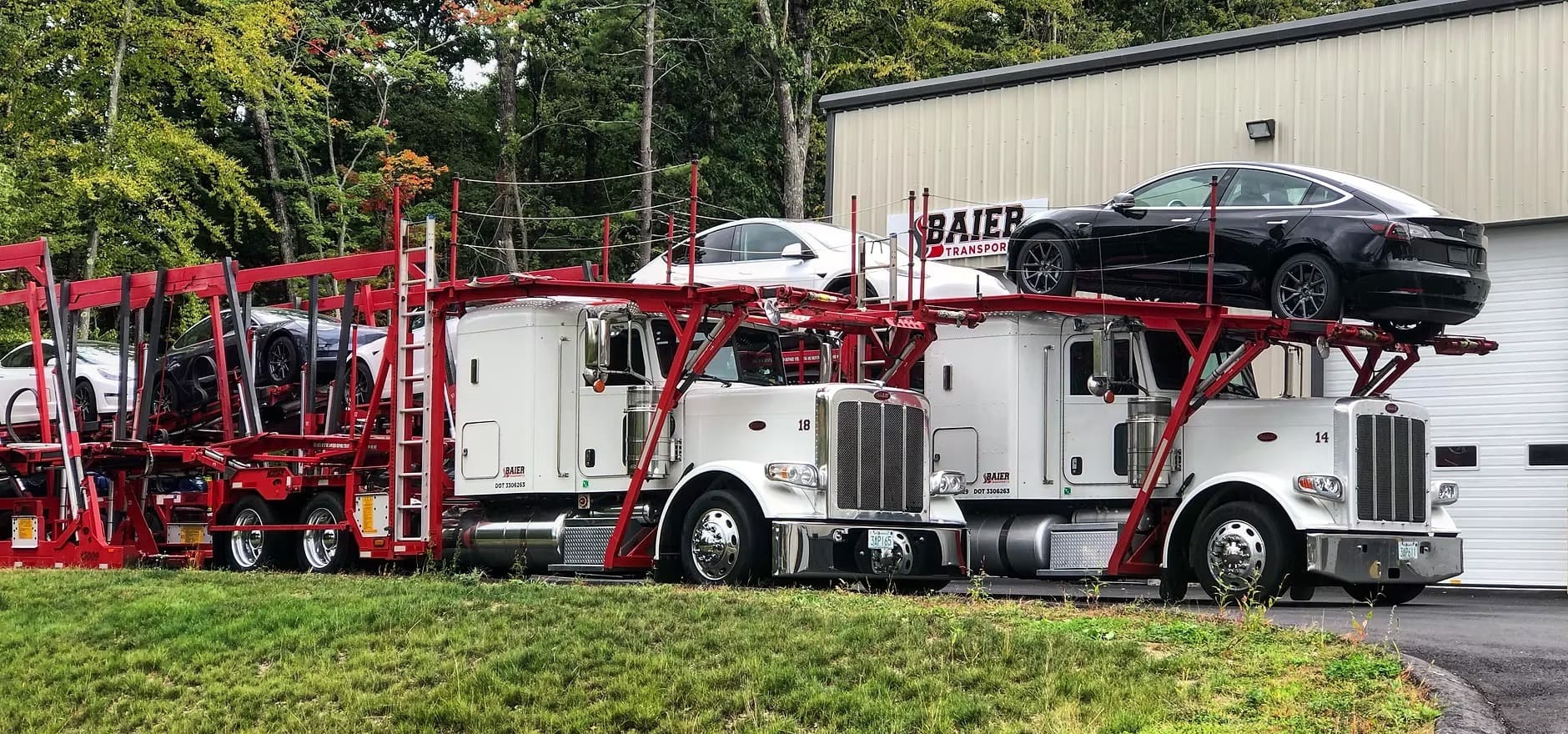
Most of these vehicles ride on an open multi-car carrier, the same two-level trailer that delivers new cars to dealerships. A standard open carrier holds 7 to 10 vehicles, so several units headed the same direction can share one truck. High-value units that should not see weather or road spray can go on enclosed transport instead.
How long commercial moves take
Baier calculates transit the same way on every lane: 400 to 500 miles of driving per day, plus half a day to load at pickup and half a day to unload at delivery, rounded up to whole days. The same rule sets the delivery window on every quote and every route page, so the number your sales team gives a customer matches the number on the paperwork. Time waiting for pickup is separate: it depends on how flexible the pickup window is and on matching the vehicle with a truck already running the lane.
| Lane | Road miles | Transit once loaded |
|---|---|---|
| Seabrook, NH to Virginia Beach, VA | 600 | 3 days |
| Seabrook, NH to Charlotte, NC | 800 | 3 days |
| Seabrook, NH to Atlanta, GA | 1,000 | 3-4 days |
| Boston, MA to Miami, FL | 1,500 | 4-5 days |
| Denver, CO to Boston, MA | 1,980 | 5-6 days |
| Los Angeles, CA to Boston, MA | 3,000 | 7-9 days |
Each lane links to its route page with pricing and lane-specific questions. For moves out west, see nationwide shipping.
What affects the price of a commercial load
Baier’s rate card is driven mainly by distance. Longer trips cost more in total but less per mile, because positioning the truck, loading and unloading cost about the same whether the trip is 300 miles or 3,000. From that distance-based starting point, a few known adjustments move the price:
- Vehicle size. A pickup truck or a large SUV takes more room on the trailer than a sedan and is priced above it.
- Open or enclosed. Enclosed transport adds 40 to 60 percent to the open price.
- Pickup timing. An exact pickup date or a short-notice pickup costs more than a flexible window, because it removes the chance to match the unit with a truck already on the lane.
- Operability. A vehicle that does not run needs a winch and more loading time, so it is priced above a running unit.
- Volume and consistency. Regular lanes and multi-unit loads let us plan trucks ahead, which is what a custom rate sheet reflects.
For a deeper walkthrough, read how auto transport pricing works and the per-mile cost guide.
Condition reports and proof of delivery
Every unit is inspected at pickup and again at delivery. The driver records existing scratches, dents and other condition notes on the vehicle condition report, and both sides sign the Bill of Lading. That record is what protects your store and the carrier if there is ever a claim, so whoever receives the car should check it before signing. Any damage has to be noted on the Bill of Lading at delivery, not the next morning.
Who hauls your car
About half of our loads ride on Baier trucks with Baier drivers. The rest move with vetted partner carriers that hold active FMCSA authority and insurance on file, booked under our broker authority (Baier Automotive Logistics, MC 1218658). Either way, Baier stays your single point of contact from quote to delivery.
Carrier: Baier Transport LLC, USDOT 3306263, MC 1049429. Broker: Baier Automotive Logistics, USDOT 3594438, MC 1218658.
B2B auto transport questions
How is pricing set for a dealer or fleet account?
Send us your usual lanes, monthly volume and vehicle mix and we build a custom rate sheet within 24 hours. Underneath, Baier’s rate card is driven mainly by distance, then adjusted for vehicle size, open or enclosed equipment, and how firm the pickup date is. Dispatch confirms the final price before a load is booked.
Do you offer NET30 billing?
Yes, for qualified dealerships. You complete a short credit application, and once it is approved shipments are billed on NET30 with one consolidated invoice at the end of each month instead of a deposit on every move.
How long does a regional dealer trade take?
A 500-mile trade works out to 2-3 days once the car is loaded under Baier’s transit rule: 400 to 500 miles of driving a day plus half a day each to load and unload. Shorter trades finish sooner. The wait for pickup is separate and depends on how flexible the pickup window is.
Which auctions do you pick up from?
We pick up from Manheim, ADESA, Copart, IAA and most independent regional auctions. Give us the gate pass and release details with the order so the driver can load as soon as the vehicle clears.
Can you move vehicles that do not run?
Yes. A non-running vehicle has to be loaded with a winch, so it needs to be declared as inoperable when you book. It still has to roll, steer and brake, and it carries an added charge because loading takes longer.
What paperwork do we get for each unit?
Every vehicle gets a condition report at pickup and again at delivery, and both sides sign the Bill of Lading. Any damage has to be noted on the Bill of Lading at delivery, so have whoever receives the car check it before signing.
Ready for Corporate Fleet Pricing?
Contact us for volume discounts and dedicated dispatch support tailored to your operation.
Or call (603) 490-7309