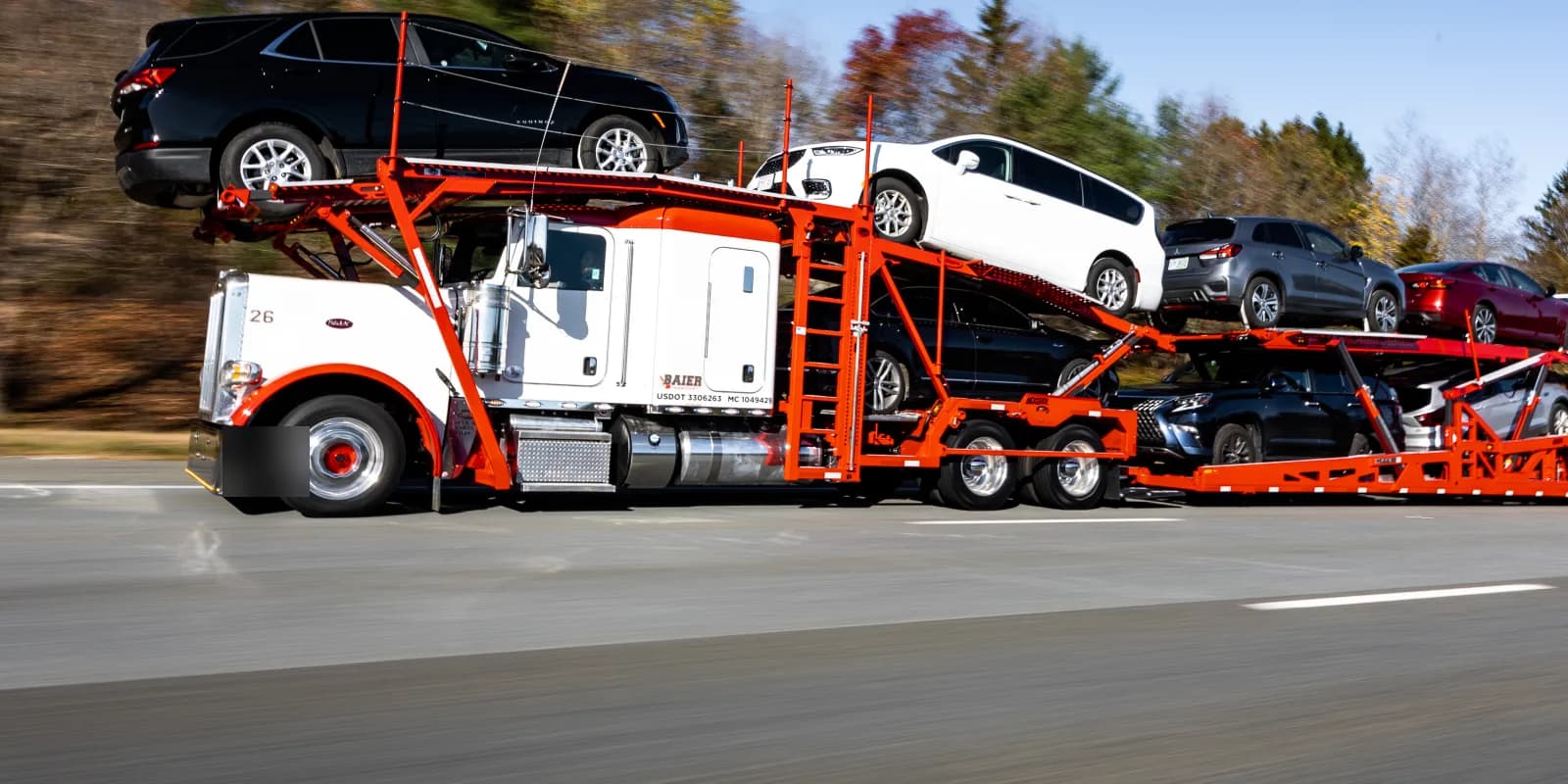
A terminal is a secured lot or facility where vehicles are dropped off, stored, and staged between trucks during transport. Carriers use terminals to consolidate cars from many local pickups onto a single long-haul trailer, and to break that trailer back down for local delivery. Customers may also drop off or collect a vehicle at one directly. Terminals are an operational tool. Whether they touch your shipment as a service option or as invisible plumbing depends on the carrier. Picture a Northeast-to-Florida run. A local shuttle truck collects four vehicles across the New Hampshire Seacoast and southern Maine over a day. Rather than sending that small truck 1,400 miles, it delivers to a regional terminal, where those cars join others already staged. A full 10-car hauler loads there and makes the linehaul run to Florida. At the Florida end, the process reverses: the trailer unloads at a destination terminal and local trucks fan out to individual addresses.
This is a hub-and-spoke model, and it is why big carriers can serve a wide collection area without sending long rigs down residential streets. Terminals typically offer fenced and often gated storage, some with covered or indoor space for high-value vehicles, plus staff to conduct condition inspections and sign the bill of lading at handoff. Most include a few days of free storage; after that, daily fees are common, often in the $20 to $40 range, though this varies widely by facility and market.
Two distinct uses to keep straight: Terminal as consolidation infrastructure. The carrier moves your car through a terminal as part of its own routing. You still get door-to-door service — the terminal leg is internal, and you never see it. Terminal-to-terminal as a product. You drive your car to a terminal and pick it up at another. This is a customer-facing service option sold at a discount to door-to-door, and it is increasingly rare in consumer auto transport.
Terminals trade convenience for cost and add a variable to your timeline. The savings on terminal-to-terminal service are usually modest — often $75 to $150 versus door-to-door on a typical route, though this varies by lane and season. Weigh that against driving to a terminal that may be 40 miles away, arranging a ride home, and repeating both at the destination. The bigger factor is dwell time. A car sitting at a terminal waiting for a full trailer is a car not moving. Your delivery estimate has to absorb that. Door-to-door service on a carrier's own scheduled run is typically faster, because the vehicle is on a truck that is already going.
There is a genuine upside: flexibility. If you are flying south on the 12th but want the car gone on the 8th, a terminal drop lets you separate those dates. For snowbirds coordinating flights and closings, that can be worth real money. The mistake is assuming terminal-to-terminal is meaningfully cheaper. Once you account for two round trips, someone's time, and the storage days, the discount often evaporates. Our door-to-door vs terminal comparison does the arithmetic.
The second mistake is not asking about free storage days and daily rates before dropping a car. Ships get delayed; trailers fill slowly in the off-season. A week of unexpected storage fees can exceed the discount that made terminal service attractive. Third: not inspecting at handoff. Get a signed condition report and photos when you drop off and when you pick up. A vehicle that changes hands at a terminal has one more transfer point where damage can occur without a witness. Baier Transport runs door-to-door on the Northeast-to-Florida corridor with our own trucks and drivers, out of Seabrook, New Hampshire. We handle the consolidation internally so you deal with one company and one handoff. 251,015+ vehicles transported. BBB A+ rated.