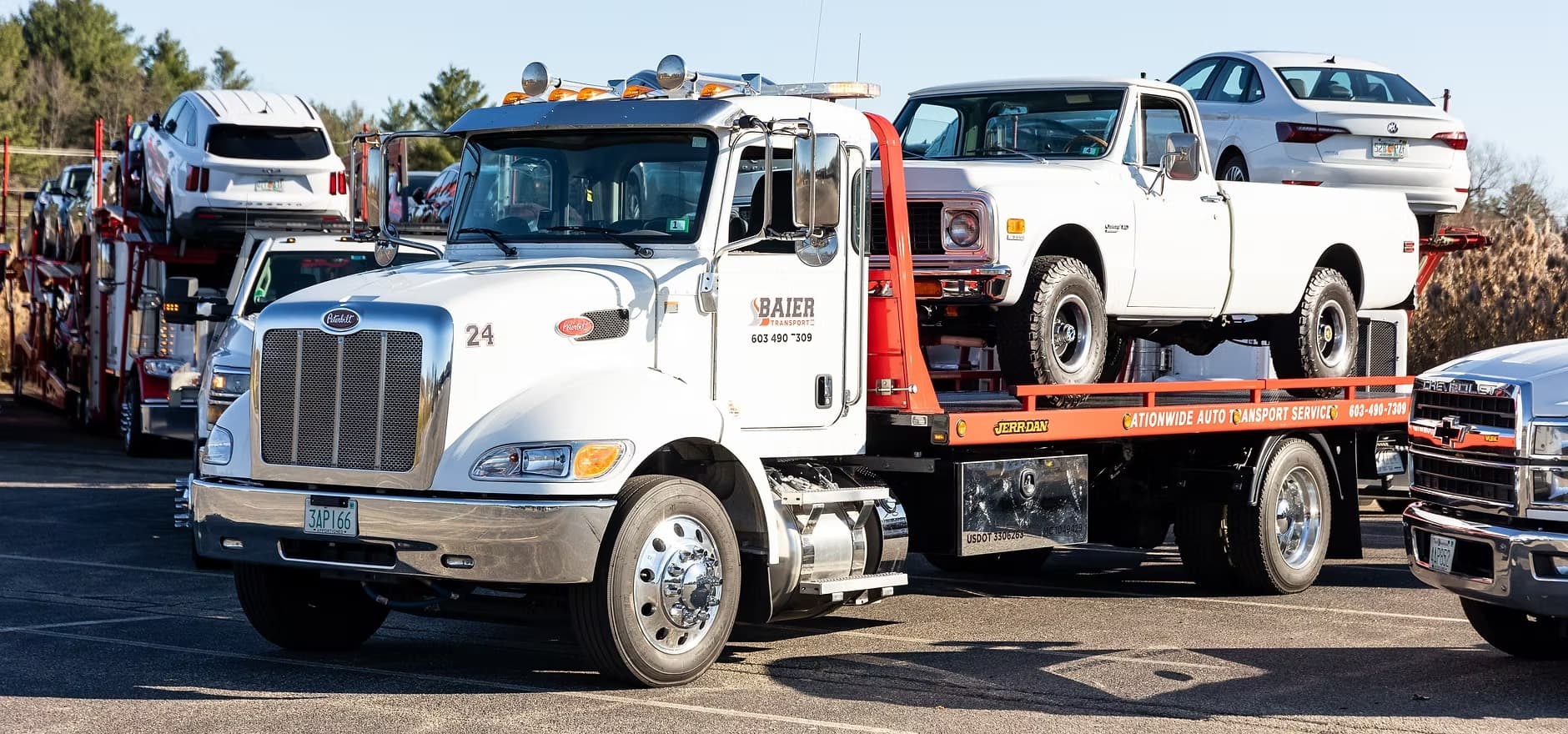
Inoperable vehicle transport, usually shortened to INOP, is car shipping for a vehicle that cannot be driven onto the trailer under its own power. It requires a truck equipped with a winch and a driver trained to use it, takes longer to load, and costs more than standard transport. The vehicle must still roll, steer, and brake.
"Inoperable" is a loading term, not a mechanical diagnosis. Carriers care about one question: can the car be moved onto and off the trailer safely? The industry sorts vehicles into three buckets: Most INOP loads are the middle bucket. The driver positions the trailer, runs the winch cable to a tow point on the frame or a factory tow hook, and pulls the vehicle up the ramps at walking speed while steering is guided. It adds 20 to 45 minutes per vehicle versus driving one on. Cost and logistics reality: Common INOP cases we see: project cars and barn finds, auction purchases sold as-is, a flood or accident vehicle heading to a body shop, a classic that has not run in years, a dealer trade-in with a dead engine, and a snowbird's second car that has sat all summer.
The condition of the vehicle has to be declared at booking, and it drives everything downstream: which truck gets assigned, how the load is built, what it costs, and how long loading takes. Get the details right and the process is routine. We move non-running vehicles regularly on our own equipment, and the winch is on the truck before it leaves Seabrook. Get it wrong and the driver arrives with a load already built around a car that drives on, discovers it does not, and cannot take it.
Also worth knowing: keys still matter. Even a car that will not start usually needs to be in neutral with the steering unlocked, which means keys. Tell the carrier if you do not have them. Declaring a car operable because "it runs, it just doesn't drive well." That includes a car with bad brakes, a dead battery, no reverse, a failed transmission, or one that starts but stalls. From the driver's perspective, all of those are inoperable.
The reason people do it is that INOP costs more and they hope it will go unnoticed. It never does — the driver finds out in the first thirty seconds. At that point you either pay the INOP rate on the spot if the truck happens to have a winch and space, or the car does not get loaded and you start over. Declare it up front. It is cheaper and it is faster.
The same applies at pickup: make sure it is noted on the vehicle inspection report so the condition is documented for both sides. Baier's own trucks are winch-equipped and our drivers load non-running vehicles regularly — project cars, auction buys, and dealer trade-ins out of ADESA Boston and Manheim New England. Get a quote and describe the car honestly; we will tell you exactly what it takes.