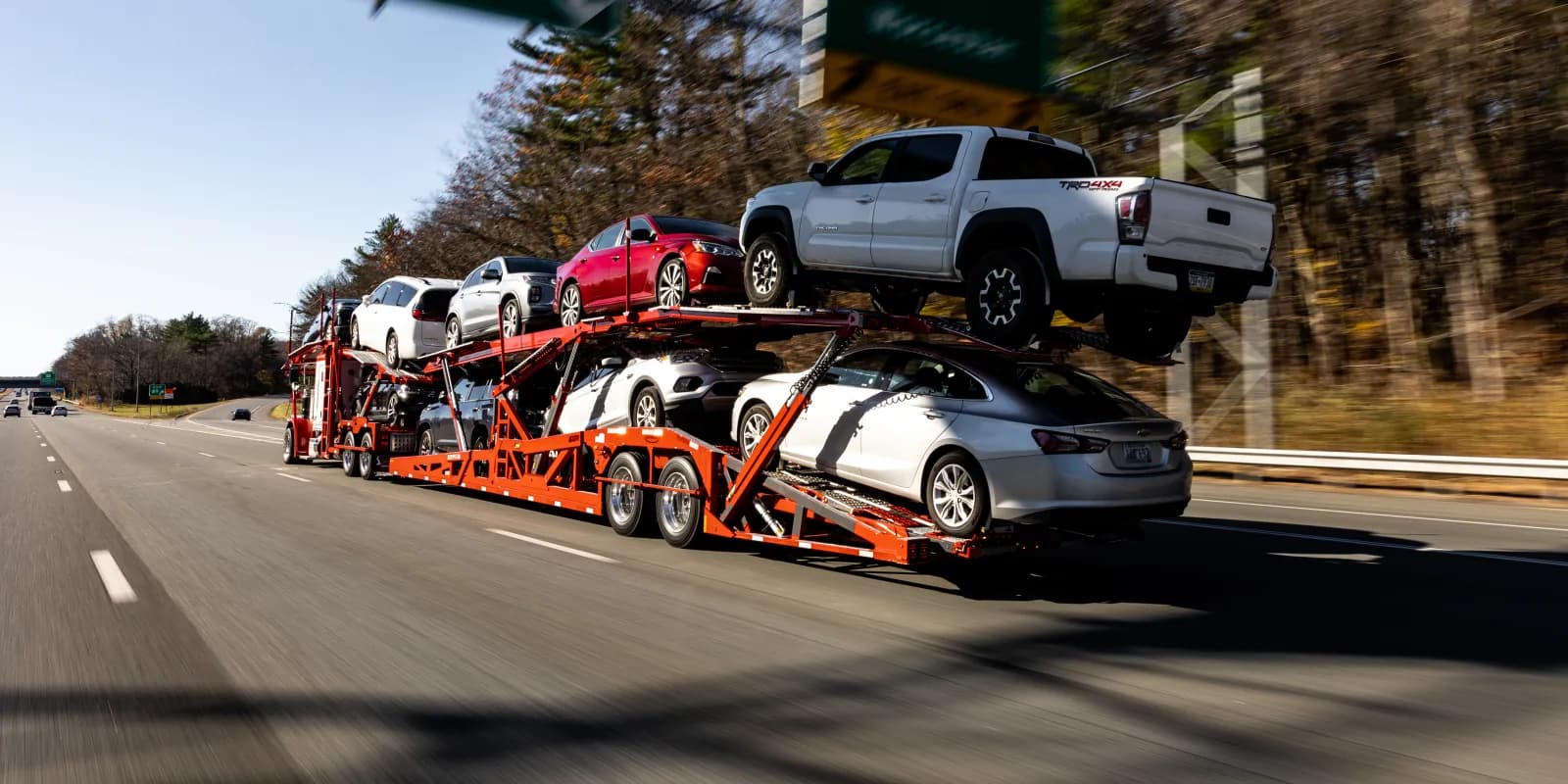
A per-mile rate is the cost of shipping a vehicle divided by the trip distance, expressed in dollars per mile. It is a comparison tool, not a price list — the rate is not flat. Short hauls cost significantly more per mile than long hauls because fixed costs like loading, permits, and driver time are spread over fewer miles.
Carriers do not price a load by multiplying miles by a fixed number. They price the load, then people divide by distance afterward to compare. What actually goes into the number: Broad market pattern, not a quote: rates published across the industry generally show something in the range of roughly $0.75 to $1.60 per mile on short runs under 500 miles, tapering toward roughly $0.40 to $0.70 per mile on runs over 1,500 miles for standard open transport. Enclosed sits above that. These are typical market ranges and vary by season, vehicle, route, and equipment — they are not a quote.
Run the math on a real corridor. Seabrook, NH to Naples, FL is roughly 1,500 miles. A per-mile figure in that longer-haul band puts an open-transport sedan somewhere in the four-figure range — but the number that matters is the one tied to your car, your dates, and your two addresses, not a national average. That is what a binding estimate is for.
Per-mile rate is useful for exactly one thing: sanity-checking a quote. If somebody quotes you $0.28 per mile on a 1,000-mile October run to Florida, that price is not going to survive contact with a real truck. It is a number designed to win the booking, followed by a call two weeks later saying no carrier will take it at that rate. The reverse is also true. If you are quoted well above the typical band, ask what is driving it — oversize vehicle, enclosed equipment, a hard pickup date, a remote address. There is usually a legitimate reason, and a carrier can tell you what it is because the carrier is the one paying the driver.
Brokers cannot really answer that question. They post your car on a load board and find out what a truck will actually take. That is why broker quotes move. More on the mechanics in how per-mile pricing actually works. Using one per-mile figure across all distances. A national average of "about $0.60 per mile" is meaningless for a 300-mile move — that trip will run closer to a dollar and change per mile, and it should, because the driver still loads, inspects, straps, drives, and unloads regardless of distance.
The second mistake is comparing quotes on rate rather than on total delivered price and terms. A slightly higher per-mile rate from a carrier that names your pickup window and hauls the car on its own truck beats a lower number from a broker that has not found a truck yet. Baier prices the load, not a formula. We own the trucks that run the Northeast-to-Florida corridor, so the number we give you is the number we can run. Get a real quote for your lane — including Boston to Miami — before the 2026-27 snowbird season fills.