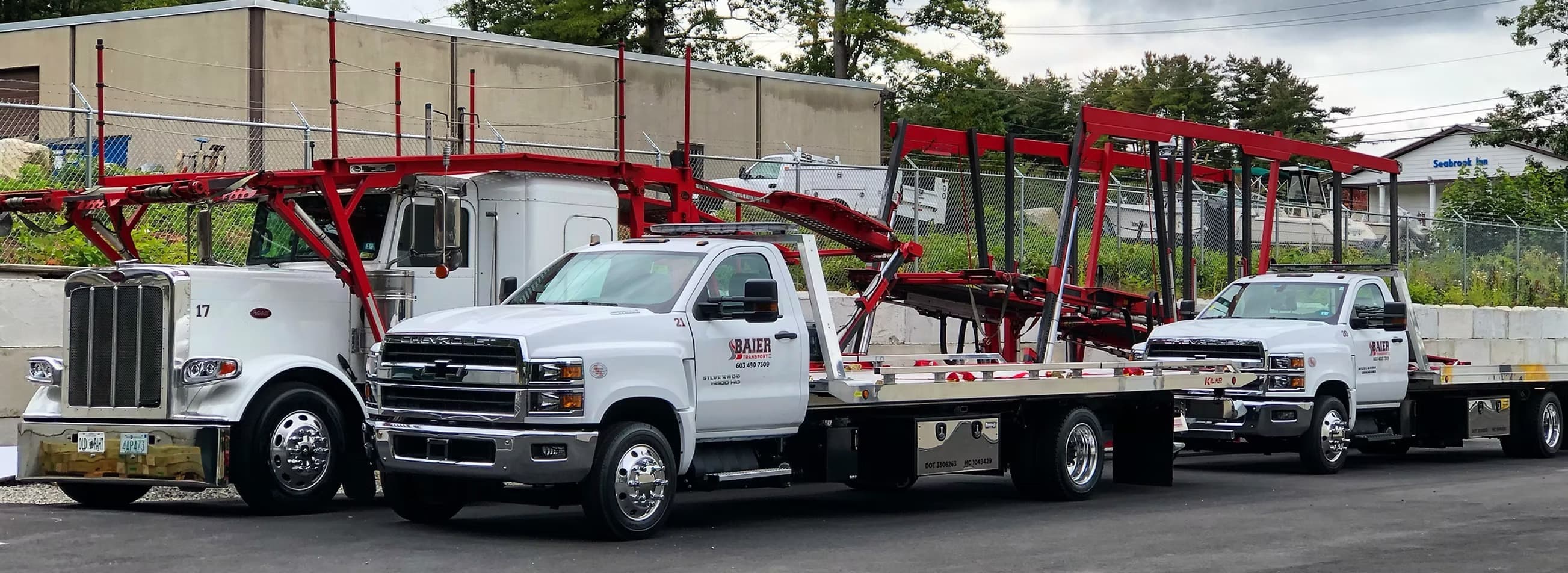
Auto Transport Companies to Avoid: 9 Red Flags Before You Pay
The auto transport companies to avoid are not usually outright criminals. They're operations that quote a price they know no truck will accept, take a non-refundable deposit, and then either raise the number or leave your car sitting. You can spot every one of them before money changes hands.
Below are nine specific red flags, in the order you'll typically encounter them. Each one includes the exact question to ask and what a legitimate answer sounds like.
The nine red flags, at a glance
| # | Red flag | The question that exposes it |
|---|---|---|
| 1 | No MC or USDOT number offered | "What's your USDOT number?" |
| 2 | A quote far below every other quote | "Is that binding, or does it change at dispatch?" |
| 3 | Large deposit demanded immediately | "Is the deposit refundable, and what earns it?" |
| 4 | Vague answers about who owns the truck | "Will my car be on your truck?" |
| 5 | Insurance described but never documented | "Email me your certificate of insurance." |
| 6 | A pickup "date" that's really a window | "Is that a guaranteed date or a first available date?" |
| 7 | Pressure to book in the next 15 minutes | "Send it to me in writing and I'll review it." |
| 8 | Wire transfer, Zelle, or cash-app payment | "Can I pay by credit card?" |
| 9 | No physical address, no terminal, no name | "Where is your yard?" |
Now the detail.
1. No MC number, no USDOT number, no answer
Every for-hire interstate transporter in the United States has a USDOT number, and virtually all have an MC number. A company that dodges the question, gives a number that doesn't match its name, or sends you a number belonging to a different entity has failed the cheapest test in the process.
What good looks like: the numbers are on the website footer and the rep states them without hesitating.
Run them yourself. The FMCSA's SAFER Company Snapshot is free and takes two minutes — we walk through the fields in how to verify a company on the FMCSA lookup.
2. The bait quote
You get five quotes. Four land between $1,150 and $1,400. One says $749. The $749 is not a better company — it's a company that has decided to win the booking and renegotiate later.
Here's why it works. Most car shipping quotes come from brokers, who post your car to a load board and let independent truckers decide whether the leftover payout is worth driving for. A payout no trucker will take doesn't move your car; it just holds your deposit while the broker waits for the market to soften or comes back asking you for more money.
The tell: ask whether it's a binding estimate or an estimate subject to change at dispatch. If the answer includes the phrase "carriers sometimes ask for more," you've found the bait.
What good looks like: a number in the realistic market band for your lane. If you don't know what that band is, start with what auto transport actually costs.
3. The deposit that buys nothing
Deposits are normal in this industry. The problem is when a deposit is large, non-refundable, taken before any truck is assigned, and defined nowhere in writing.
Ask three questions: Is it refundable, and until what point? What makes it non-refundable — dispatch, or the moment I pay? What's the cancellation fee if no truck is ever assigned?
What good looks like: clear written terms, an amount tied to dispatch rather than to your signature, and a refund path if the company never produces a truck. If a company won't put its deposit terms in an email, don't pay it.
4. Nobody will tell you whose truck it is
This one is subtle because the answer is often technically true. "We work with a network of vetted carriers" means the company doesn't own trucks. That's a legitimate business model — it's just not the one most customers think they're buying.
Ask flatly: "Will my vehicle be on a truck your company owns, or will you post it to another carrier?"
What good looks like: either "yes, it's our truck, here's the driver's name," or "no, we're a broker, we'll assign a carrier and send you their details." Both are honest. Silence, deflection, or "same thing" is not.
5. Phantom insurance
The most expensive red flag. A rep says "your car is fully insured up to $250,000" and never sends a document.
Here's how carrier insurance generally works: the motor carrier that physically hauls your vehicle carries cargo insurance that responds to damage caused during transport, subject to policy limits, deductibles, and exclusions. A broker's surety bond is financial security for unpaid carriers — it is not coverage for your vehicle. Your own auto policy may or may not apply during commercial transport; check with your agent.
What good looks like: the company emails you a certificate of insurance naming itself as the insured, showing the cargo limit, the deductible, and the policy dates. Read it. Ask what's excluded — acts of nature and personal items in the vehicle usually are.
What to avoid: verbal-only coverage claims, a certificate belonging to a company you've never heard of, a policy expiring before your delivery date, or any promise phrased as a guarantee. Nobody can guarantee an insurance outcome to you over the phone.
6. A "date" that isn't a date
"We'll pick up Thursday" can mean two completely different things. A guaranteed pickup date is a commitment. A first available date is the beginning of a window that might run three to seven days — or longer during peak snowbird season.
Brokers usually cannot guarantee a date, because they don't control any trucks. That's not dishonest by itself. Presenting a window as a promise is.
The question: "Is that a guaranteed date, or the first date I'm available for pickup?"
What good looks like: a carrier with its own dispatch tells you which truck, which run, and what the window is. Everyone should be able to tell you which one they're offering.
7. Manufactured urgency
"This rate is only good for the next 15 minutes." "I have one slot left on Thursday's truck."
Real capacity constraints exist — southbound Northeast-to-Florida trucks genuinely fill up in October and November. But a real constraint survives being put in writing. Say "email me the quote and terms and I'll review it today." A legitimate operation sends the email. A boiler room escalates.
8. Payment methods with no recourse
Wire transfer, Zelle, Venmo, Cash App, gift cards, or crypto for a deposit are all functionally irreversible. That's the point — it removes your ability to dispute.
What good looks like: a credit card for the deposit (which gives you chargeback rights), and often cash, certified check, or card on delivery. Cash on delivery to the driver is a normal, long-standing industry practice and isn't a red flag by itself. An irreversible up-front payment to a company you can't verify is.
9. No physical presence
Look for a street address, not a suite number in a state the company never mentions again. A carrier has a yard: trucks, a gate, a place your car can sit. A brokerage may legitimately be an office — but it should still be a real one with a real name attached.
Also check whether a human name appears anywhere. Ours is Jay Baier, owner/operator, Seabrook, New Hampshire. Anonymous companies are harder to hold accountable, and they know it.
What to do if you've already paid
- Get everything in writing now. Email the company summarizing what you were told and ask them to confirm.
- Look up the MC/USDOT number in SAFER and confirm it matches the name on your paperwork.
- Dispute the charge with your card issuer if the company fails to produce a truck or a written agreement.
- File a complaint with the FMCSA's National Consumer Complaint Database and with the BBB.
- Document the vehicle before any pickup — photograph every panel, wheel, and the odometer, and make sure the vehicle inspection report on the bill of lading matches what you see. Never sign a blank or pre-marked condition report, at pickup or delivery.
The shortcut
Almost every red flag on this list collapses into one question: does this company own the truck, and can it prove it?
If yes, the price is real, the date is real, and there's one insurance certificate to read. If no, you're not necessarily in trouble — brokers are a legitimate and sometimes better option — but you need to know it, and the company needs to say it.
Baier Transport LLC is an owned-fleet carrier in Seabrook, New Hampshire with a BBB A+ rating and 251,015+ vehicles moved. We run the Northeast-to-Florida corridor with our own trucks and our own drivers, plus the ADESA Boston and Manheim New England auction lanes for dealers like Team Nissan, AutoFair, Berlin City Auto, and Merchants Auto.
Working through a decision right now? Use the full nine-point checklist — it covers everything above plus pricing, timing, and transport type in order.
Frequently Asked Questions
What is the biggest red flag in auto transport? A quote significantly below every other quote you received. Low bait quotes are used to secure a deposit, after which the price rises because no truck will accept the payout the company offered. Ask whether the number is binding or changes at dispatch. If the answer includes "carriers sometimes ask for more," treat the quote as a placeholder, not a price.
Should I ever pay a deposit for car shipping? Deposits are normal, but only with written terms. Ask what makes the deposit non-refundable, whether it's tied to dispatch or to signing, and what happens if no truck is ever assigned. Pay by credit card so you retain chargeback rights, and never send a deposit by wire, Zelle, or a cash app to a company you haven't verified in the FMCSA database.
How do I check if an auto transport company is legitimate? Look up its USDOT number on the FMCSA SAFER Company Snapshot at safer.fmcsa.dot.gov. Confirm the legal name matches, the USDOT status is active, there's no out-of-service date, and the Entity Type says CARRIER or BROKER as the company claims. Then request a certificate of insurance naming that company as the insured.
Is a broker automatically a company to avoid? No. Brokerage is a licensed, legal model and it's the right answer for unusual or long-distance lanes where no single fleet runs regularly. What you should avoid is a broker that won't say it's a broker. Ask directly whether your car goes on their truck or gets posted to another carrier, and expect a straight answer.
What should I do if my car is damaged in transport? Note every new item of damage on the bill of lading before you sign at delivery, and photograph it in the driver's presence. A signed clean delivery receipt makes a claim significantly harder. Then file the claim with the carrier that hauled the vehicle, referencing the certificate of insurance you requested before pickup. Ask about the deductible up front.
Are cheap car shipping quotes ever real? Sometimes. A genuinely low price usually means a truck is already running that route with an empty slot, which happens most often on northbound backhauls and off-peak weeks. The difference is that a real low price is quoted as binding by a company that owns the truck, while a bait quote is always described as subject to change once a carrier is assigned.
Ask us the hard questions
We'd rather you interrogate us than get burned. Ask for our USDOT number, our certificate of insurance, and the name of the driver on your run — we'll send all three.
If you're moving a vehicle between New England and Florida this season, get a quote from an owned-fleet carrier and compare it against whatever else you've been offered.
Ready to Ship Your Vehicle?
Free, no-obligation quote from Baier Transport. BBB A+ rated with over 251,015+ vehicles transported.
Or call (603) 490-7309