How Auto Transport Pricing Actually Works (And Why Quotes Vary So Much)
You get three quotes for the same shipment and they're $400 apart. What's going on?
Every auto transport price is built from the same six factors. Once you know what they are and how much each one moves the number, you can read a quote in a minute and tell whether it is realistic or a lowball that will come back to bite you.
What you'll learn
- Distance sets the base price, and longer trips cost less per mile Vehicle size, operability, open vs enclosed and pickup timing adjust it up from there A quote far below the pattern for your distance is a warning sign, not a bargain
The six factors in every quote
1. Distance ($/mile) — The base rate. Long-haul costs less per mile than short-haul because the fixed costs (loading, dispatch) get spread out.
2. Lane density — A Chicago–Atlanta load is cheap because carriers run that lane daily. A Bismarck–Burlington load is expensive because almost nobody's going that direction.
3. Vehicle type — A sedan, SUV, dually pickup, and motorcycle all take different trailer slots. A dually takes the space of two regular cars.
4. Operability — Non-running vehicles need a winch and an operator who knows how to load deadweight. Add $150–$300.
5. Transport type — Open is the baseline. Enclosed adds 40–60%.
6. Timing — An exact pickup date costs more than a flexible window, and a short-notice pickup carries a surcharge. Expedited service costs more again.
The sections below take each factor in turn.
Distance: the base of every price
Baier's rate card is driven mainly by distance. That sounds obvious, but the way distance works surprises people: the total price goes up with miles, while the price per mile goes down.
Here is why. Some costs don't depend on how far the car goes. The truck has to get into position, the driver has to load and secure the car, and at the other end it has to be unloaded and inspected. Under Baier's transit rule, loading and unloading take about half a day each on their own. On a long trip those fixed costs are spread over more miles.
You can see it on Baier's published lanes for an open, running sedan with a flexible pickup date:
| Lane | Road miles | Sedan price range |
|---|---|---|
| Los Angeles → New York | 2,800 | $1,950–$2,375 |
| Denver → Boston | 1,980 | $1,550–$1,900 |
| Kansas City → Boston | 1,420 | $1,250–$1,500 |
Los Angeles to New York works out to roughly $0.70 to $0.85 per mile. Kansas City to Boston, about half the distance, works out to roughly $0.88 to $1.06 per mile. For the full table and the math behind it, see the auto transport cost per mile guide.
Lane density: where trucks already go
A truck that is already running your lane can take your car at a fair price. A truck that has to drive empty to reach you, or come back empty afterward, has to charge for those miles. That empty driving is called deadhead, and it is the reason a busy corridor is cheaper per mile than a remote one. On Baier's rate card, pickups in remote-area states price higher than comparable lanes of the same length.
The New England to Florida corridor is a good example of how density works with the calendar. In the fall, demand to Florida peaks with snowbird season, and October and November sit at the top of the price band. In spring the flow reverses.
Vehicle size and type
A car carrier has a fixed amount of deck space and a weight limit. A larger vehicle uses more of both. On Baier's rate card, a pickup truck adds about $225 to $325 over a sedan on the same lane, and a large SUV adds about $250 to $500. Very tall vehicles can't ride in some positions at all, which limits how a load can be built.
Operability
A vehicle that doesn't run can't be driven onto the trailer. It has to be pulled up with a winch, which takes longer and needs a truck equipped for it. That's why a non-running car costs more, and why it has to be declared as inoperable when you book. The car still has to roll, steer and brake. If a driver arrives expecting a running car and finds one that won't start, the load may not have room or equipment for it, and you start over.
Ready to Ship Your Vehicle?
Get a free, no-obligation quote from Baier Transport. BBB A+ rated with over 251,015+ vehicles transported.
Or call (603) 490-7309Open or enclosed
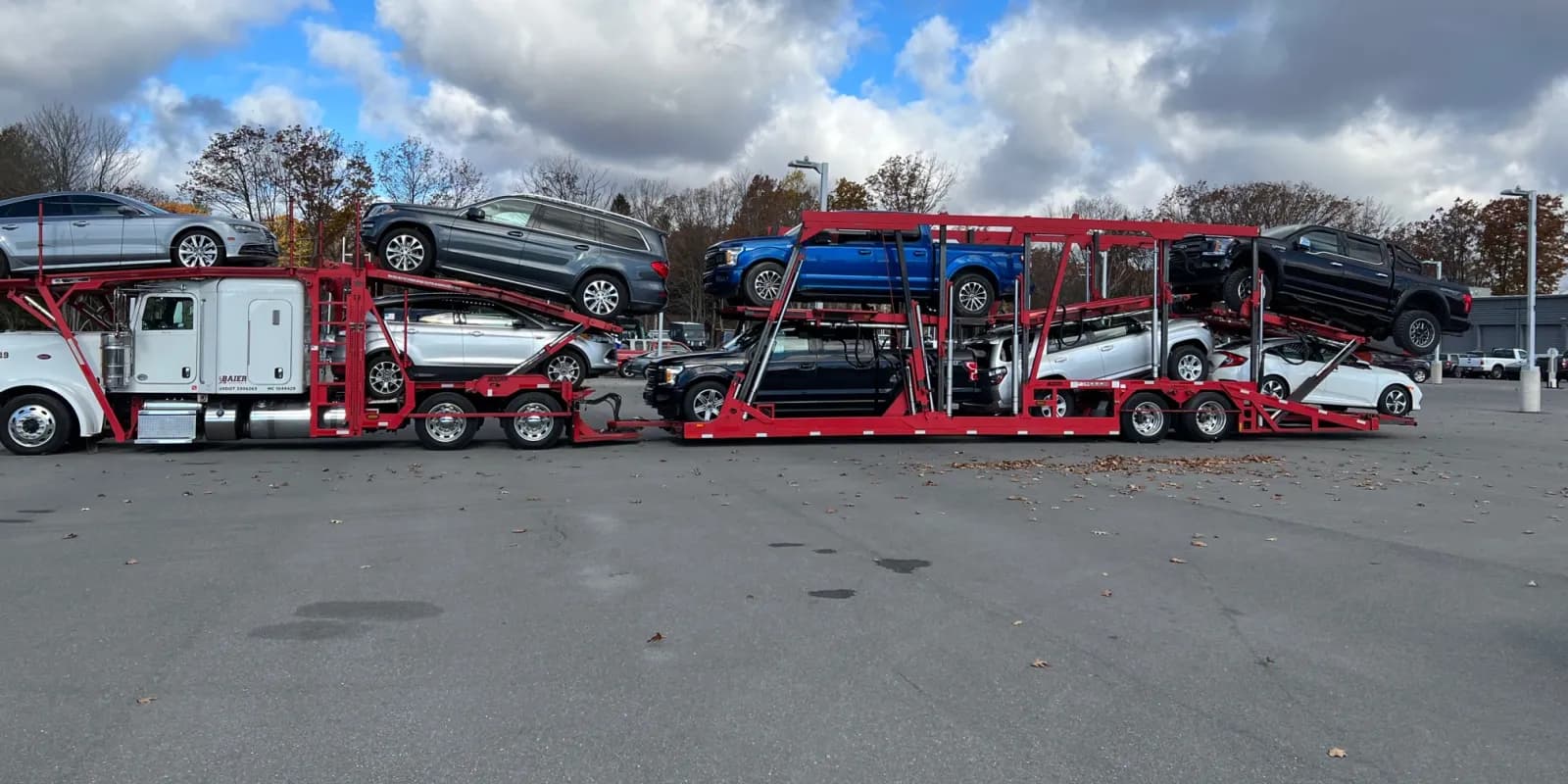
Open transport is the standard way vehicles move, on the same two-level trailers that deliver new cars to dealerships. Enclosed transport puts the car inside a covered trailer that carries fewer vehicles, which is why it adds 40 to 60 percent to the open price. It's worth it for a finish you can't replace. For a daily driver, it's usually money you don't need to spend. See open vs enclosed transport for how to decide.
Timing and flexibility
A flexible pickup window lets dispatch put your car on a truck that is already heading your way. An exact pickup date takes that flexibility away, so on Baier's rate card it adds about $175 to $325. A short-notice pickup carries its own surcharge.
Expedited service goes further. Priority dispatch moves your car to the front of the queue for a smaller premium, and a dedicated truck that carries only your vehicle costs considerably more. Neither one makes the truck drive faster. Federal hours-of-service rules still limit the drive, which is why Baier plans every lane at 400 to 500 miles a day either way.
The cheapest way to ship is to book early with an honest first available date and a few days of flexibility.
One price that works differently: the Snowbird program
Most auto transport prices are quoted as a total. Baier's 2026–27 Snowbird Fixed-Price Program is quoted per mile instead: $1.20 per mile from New Hampshire, Maine or Massachusetts, and $1.35 per mile from Vermont, New York, Connecticut, Rhode Island or New Jersey, to anywhere in Florida. The price is road miles times the rate, rounded to the nearest $5, for open transport of a running vehicle. Details are on the snowbird page.
How to read a quote
When the quotes come in, check each one for the same things:
- The vehicle and route are right. Year, make, model, running or not, and the actual pickup and delivery ZIP codes.
- Open or enclosed is stated. A cheap "enclosed" quote may be for a different kind of trailer than you expect.
- The pickup terms are clear. Is it a window starting on your first available date, or a guaranteed pickup date?
- The total is in line with the distance. Compare it to the per-mile pattern above. A price far below it deserves a question before you pay a deposit.
Some brokers quote low to win the booking, then call you back two days later saying "no carrier picked it up, we need another $300." By then you have planned around a date and lost time you could have spent booking elsewhere.
The honest answer to "why do quotes vary so much": some quotes are prices and some are guesses about what a carrier might accept. Baier's dispatch confirms the final price before you book, and that confirmed price is what you pay, with no hidden fees.
Frequently Asked Questions
What is the biggest factor in the price of shipping a car? Distance. Baier's rate card is driven mainly by road miles, and everything else adjusts from that starting point.
Why is a short trip more expensive per mile? Positioning, loading and unloading cost about the same on a short trip as a long one. On a short trip those costs are spread over fewer miles.
How much more does enclosed transport cost? On Baier's rate card, enclosed transport adds 40 to 60 percent to the open price.
Does a non-running car cost more to ship? Yes. It has to be loaded with a winch, which takes more time and the right equipment.
How can I lower my price? Book early, give a realistic first available date with a few days of flexibility, choose open transport for an everyday car, and avoid paying for an exact date you don't need.
Get a real number
Run your route through the instant quote to see your price for your ZIP codes, vehicle and dates. If you'd rather talk it through, contact our team Monday through Friday, 8:00 AM to 6:00 PM ET.
Ready to Ship Your Vehicle?
Free, no-obligation quote from Baier Transport. BBB A+ rated with over 251,015+ vehicles transported.
Or call (603) 490-7309