Auto Transport Companies That Are Not Brokers: Find a Real Carrier
Auto transport companies that are not brokers are called motor carriers: they hold FMCSA motor carrier authority, own trucks, employ drivers, and carry cargo insurance in their own name. You can confirm any company's status in about three minutes, for free, using the government's SAFER lookup — no phone call and no guessing required.
The catch is that most of the biggest names in car shipping are brokers, and almost none of them say so on the page you land on. This guide shows you exactly where to look, what the fields mean, and the five questions only a real carrier can answer.
What "not a broker" actually means in FMCSA terms
The FMCSA licenses two different things, and a company can hold either or both:
- Motor carrier authority — permission to physically haul freight for hire. Requires filed liability insurance. This is a carrier.
- Broker authority — permission to arrange transportation performed by someone else. Requires a $75,000 surety bond. This is a broker.
Both are issued under docket numbers with an MC prefix. That's the first thing to unlearn: there is no separate "MC-B" number you can spot at a glance. A broker's MC number looks exactly like a carrier's. What differs is the authority type on file — Common, Contract, or Broker — and whether the company has trucks behind it.
So don't try to judge by the number. Judge by the record.
How to verify a carrier in 3 minutes (step by step)
Step 1: Open the FMCSA SAFER Company Snapshot
Go to safer.fmcsa.dot.gov and choose Company Snapshot. Search by USDOT number if you have it, or by company name. It's free and requires no account.
If a company won't give you its USDOT number or MC number when you ask, stop there. Every legitimate operator has both memorized or on the footer of their site.
Step 2: Read the Entity Type field
This is the single most important line on the page.
| Entity Type shows | What it means |
|---|---|
| CARRIER | Holds motor carrier authority. Owns or operates trucks. |
| BROKER | Arranges transport performed by other companies. No trucks. |
| CARRIER/BROKER | Holds both. Sometimes hauls, sometimes posts your load out. |
| FREIGHT FORWARDER | Consolidates and re-ships. Not your truck either. |
| SHIPPER | Not a for-hire transportation provider at all. |
Step 3: Check Power Units and Drivers
Scroll to the company information block. Power Units is the number of trucks the company reported on its MCS-150 filing. Drivers is the reported driver count.
A carrier with an owned fleet reports real numbers here. A brokerage typically reports 0 power units — or the record simply isn't a carrier record at all. If a company calls itself a carrier and shows 0 power units, that mismatch is your answer.
Step 4: Confirm the Operating Authority Status
Look for Operating Authority Status and USDOT Status. You want ACTIVE and AUTHORIZED. An "Out of Service Date" that isn't blank means the company is not legally operating. Also glance at Cargo Carried — a genuine auto hauler lists Motor Vehicles.
Step 5: Cross-check the authority type in Licensing & Insurance
For the full picture, use the FMCSA's Licensing & Insurance system at li-public.fmcsa.dot.gov. It shows three separate authority lines — Common, Contract, and Broker — each marked Active, Inactive, or None.
A pure carrier shows Common and/or Contract active and Broker as None. A pure broker shows the reverse. A dual-authority company shows both active, and that's where you need to ask a follow-up question rather than assume.
That same system shows insurance filings on record. It confirms a policy exists — it does not tell you the limits that apply to your car, which is why you still request the certificate of insurance directly.
The dual-authority trap
Here's the nuance nobody writes about. Plenty of companies hold both carrier and broker operating authority. That's legal and often sensible — a regional fleet may run its own lanes and broker the rest.
The problem is when a dual-authority company markets itself as "a carrier, not a broker" and then brokers 90% of its volume anyway. The SAFER record won't tell you the split.
So ask this, in writing, before you pay:
"Will my vehicle be transported on a truck your company owns, or will this load be posted to another carrier? If it's posted out, tell me now."
An owned-fleet carrier answers in one sentence. Anything vaguer than that is an answer too.
Five questions only a real carrier can answer
Ask these on the phone. Time the pauses.
- "How many trucks do you own, and what type?" A carrier names a number and describes its equipment — open multi-car trailers, enclosed, how many slots.
- "Where is your terminal?" A carrier has a physical yard. Ours is in Seabrook, New Hampshire, about 12 miles from Portsmouth and 45 miles north of Boston.
- "Who is my driver, and can I reach dispatch directly?" A carrier's dispatcher knows the driver by name and knows where the truck is right now.
- "Can you send me your certificate of insurance with your company as the named insured?" A carrier emails it. A broker sends someone else's, or nothing.
- "Is this price binding, or does it change when a carrier is assigned?" A carrier's price doesn't need a second party to approve it.
The reason question 5 matters is the economics underneath it. A broker's quote is a bid it hopes a trucker will accept; if nobody does, the number moves, and that's why your price can change after you've already paid a deposit.
What a carrier's paperwork looks like
When you ship with an actual carrier, three documents come from the same company:
- The quote, issued by the company that owns the truck.
- The bill of lading, signed by that company's driver at pickup and again at delivery. It doubles as your condition report.
- The certificate of insurance, naming that company as the insured.
If those three documents carry three different company names, you didn't hire a carrier. You hired a broker, and the third name is the one that actually has your car.
Honest limits: when "not a broker" isn't the right goal
We're an owned-fleet carrier and we're still going to say it: chasing a carrier for every shipment is the wrong rule.
No carrier covers the whole country with its own trucks. If a company claims all 50 states with an owned fleet, it's brokering and calling it something else. For a genuinely odd lane — rural Montana to rural Maine, a golf cart, a one-off cross-country move with wide-open dates — a good broker will find a truck faster than any single fleet can.
The right rule is narrower and more useful: on a lane a carrier actually runs, hire the carrier. Everywhere else, hire a broker who admits it is one.
What we run
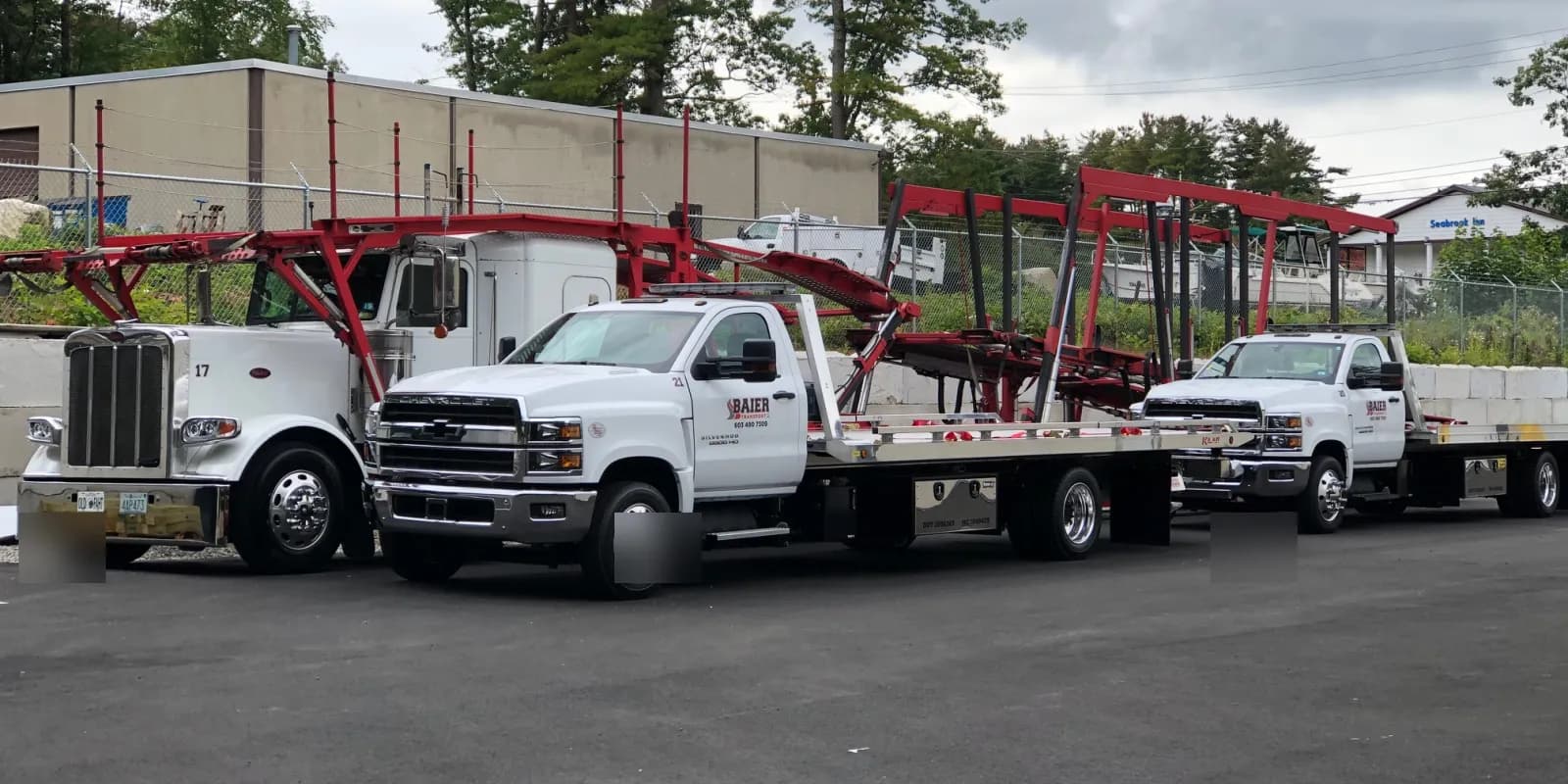
Baier Transport LLC is an owned-fleet auto carrier headquartered in Seabrook, New Hampshire. Owner Jay Baier's trucks have moved 251,015+ vehicles, and the company holds a BBB A+ rating.
Our core lane is the Northeast-to-Florida snowbird corridor — NH, MA, ME, NY, NJ, and CT down to Miami, Orlando, Tampa, Fort Myers, Naples, Sarasota, and West Palm. We also run the ADESA Boston (Framingham, MA) and Manheim New England (North Dighton, MA) auction lanes for dealer clients including Team Nissan, AutoFair, Berlin City Auto, and Merchants Auto. Our sister company, Baier Automotive Logistics LLC, handles B2B brokerage — separately, and under its own name, so you always know which one you're dealing with. More detail is on the about Baier Transport page.
If a company you're considering fails the SAFER check, don't just move on — read the red flags to watch for before you pay, because a missing MC number rarely travels alone.
Frequently Asked Questions
How can I tell if an auto transport company is a broker or a carrier? Look the company up on the FMCSA SAFER Company Snapshot at safer.fmcsa.dot.gov and read the Entity Type field. CARRIER means it holds motor carrier authority and operates trucks. BROKER means it arranges transport performed by others. Also check Power Units: a real fleet reports trucks, a brokerage typically reports zero.
Is there an MC-B number for brokers? No. Broker and carrier authority are both issued under MC-prefixed docket numbers, so you cannot tell them apart by the number itself. The difference appears in the authority type on file. The FMCSA Licensing & Insurance system at li-public.fmcsa.dot.gov lists Common, Contract, and Broker authority separately, each marked Active, Inactive, or None.
Can a company have both carrier and broker authority? Yes, and many do. Holding both is legal and common for regional fleets that run their own lanes and broker everything outside them. The public record won't show you the split, so ask directly whether your specific vehicle will ride on their truck or be posted to another carrier, and get that answer before paying.
Do carriers cost more than brokers? Not usually on a lane the carrier already runs, because there's no 15 to 25 percent middle layer between you and the truck. On unusual or low-density lanes a broker often finds a better price because it can reach a truck that's already headed that way. These are typical market dynamics and vary by season, vehicle, and route.
What insurance should a real carrier be able to show me? Ask for a certificate of insurance listing the carrier as the named insured, showing both liability and cargo coverage, plus the cargo limit and deductible. Carrier cargo insurance generally covers damage caused by the carrier during transport, with exclusions such as acts of nature and personal items. Read the certificate and ask about exclusions before pickup.
What if a company won't give me its USDOT number? Treat that as disqualifying. Every legitimate for-hire interstate transporter has a USDOT number and can state it immediately. Refusing, stalling, or giving a number that doesn't match the company name in SAFER means you cannot verify who is handling a vehicle worth tens of thousands of dollars.
Verify us, then call us
Run the SAFER lookup on any company you're considering — including ours. Then, if you're moving a vehicle between New England and Florida, ask us the only question that matters: is it your truck? On our lane, it is.
Send us your two ZIP codes, vehicle, and date window and get a quote directly from the fleet that will haul it.
Ready to Ship Your Vehicle?
Free, no-obligation quote from Baier Transport. BBB A+ rated with over 251,015+ vehicles transported.
Or call (603) 490-7309