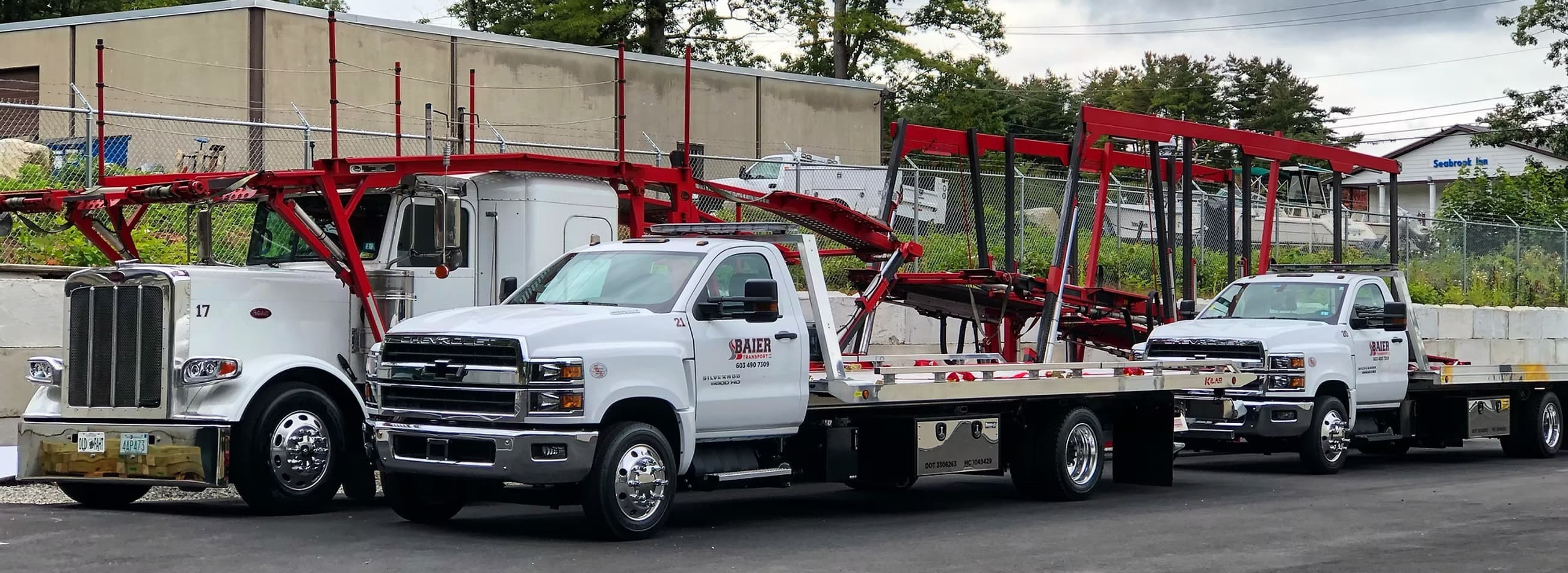
A multi-car carrier is the tractor-trailer rig that hauls 7 to 10 vehicles at once on a two-level hydraulic trailer. It is the workhorse of auto transport — roughly 75 to 80 feet long, up to 13.5 feet tall, and up to 80,000 pounds gross. If your car ships on an open trailer, this is the equipment underneath it.
The trailer has an upper and lower deck, each split into hydraulically adjustable ramps. The driver raises, lowers, and angles individual decks so that a Suburban and a Miata can ride on the same truck without the Suburban's roof hitting the deck above it. Capacity is governed by weight, not slots. Federal gross vehicle weight limits cap the whole rig at 80,000 pounds. The tractor and trailer eat roughly 32,000 to 35,000 pounds of that, leaving about 45,000 pounds of cars. Nine sedans at 3,500 pounds fits. Nine full-size pickups at 6,000 pounds does not. That is why heavy trucks and large SUVs cost more to ship — they consume two cars' worth of payload.
Loading order is dispatch strategy. A driver running Seabrook, NH to Fort Myers loads last-delivered cars first, deepest in the trailer. Your car's position determines both when it comes off and how much repositioning it takes to unload the vehicle in front of it. Ask for top load if that matters to you.
Routing is the reason transit takes days. A truck with 9 cars has up to 9 pickups and 9 deliveries. Even running 400 to 500 legal miles a day, a nine-stop route from New England to Florida realistically takes 4 to 7 days. That is not slowness; it is arithmetic. Empty miles cost money. A carrier that hauls 9 cars south and returns empty — see deadhead — must price the round trip into the southbound rate. This is exactly why the Northeast-to-Florida lane is cheaper for operators who also run northbound loads in the spring.
Every quote you receive is a share of one truck's operating cost. Understanding the truck explains most of what confuses customers about auto transport: We run our own multi-car carriers out of Seabrook down I-95 to Florida. When we tell you a departure date, we are reading our own dispatch board — not hoping somebody bids.
Assuming the truck can add your car "on the way." Loading a mid-trailer slot may require offloading and repositioning three other vehicles, which takes an hour in a parking lot the driver may not legally be able to use. Also: never guess your vehicle's weight or modifications. Lift kits, roof racks, and oversized tires change deck clearance. Tell the carrier at booking, not at the curb. Our trucks, our drivers, our dispatch board — 251,015+ vehicles moved and a BBB A+ rating. Get a quote with your ZIP codes, or see everything we run on our services page.