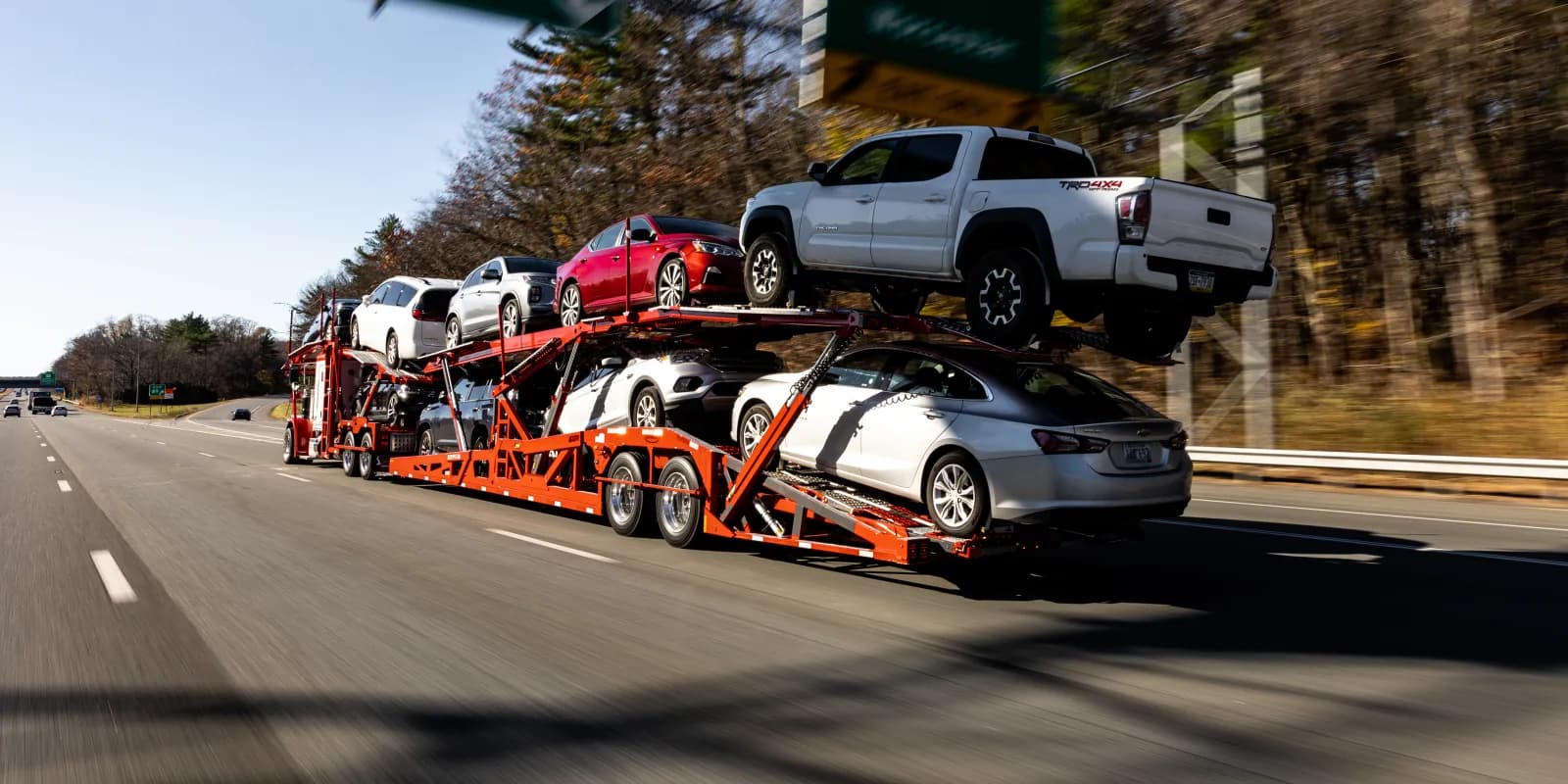
Auto transport is the business of moving a vehicle from one place to another on a truck instead of driving it. A licensed carrier loads your car onto a multi-car trailer or enclosed trailer, hauls it over the road, and delivers it to an address or terminal. It is also called car shipping or vehicle transport. Everything else — open versus enclosed, door versus terminal, who actually touches your car — is detail layered on top of that one transaction. The process has five steps and they are the same whether you are moving one car or forty.
The steps run in order: you get a quote using origin and destination ZIP codes, vehicle details, and your first available date; the load is booked and dispatched to a truck (an auto transport carrier assigns its own driver, while an auto transport broker posts the load to a board and waits for a stranger to accept it); the driver inspects the car with you at pickup and you both sign the Bill of Lading; the vehicle rides in transit, with a standard multi-car carrier holding 7 to 10 vehicles and running roughly 400 to 500 miles a day under federal hours-of-service limits; and finally a second inspection, signature, and balance payment happen at delivery. Any damage has to be noted on the Bill of Lading at delivery, not the next morning.
Typical market pricing on the Northeast-to-Florida lane runs roughly $900 to $1,600 for an open, operable sedan, with enclosed running 40% to 60% higher. Those ranges move with season, vehicle size, and fuel costs, with snowbird season in October and November sitting at the top of the band.
The single most useful thing to know about auto transport is that most of the largest national advertisers hold broker authority rather than carrier authority — they sell your load into a network, and a trucking company you did not choose shows up. That is not automatically bad; on an obscure lane, a broker working a network of thousands of independent carriers can find a truck when nobody else can. But on a lane a carrier actually runs every week, going direct removes a middleman and a markup, and it means the company that quoted you is the company that answers when you call. You can check any company's authority type yourself in the FMCSA SAFER database in about a minute.
One mistake worth naming: assuming the cheapest quote is the price you will pay. A broker quote is an estimate of what a carrier might accept, and if no driver takes the load at that number, the price often gets "revised" a week later — usually the week you needed the car gone. Ask one question before you pay anything: do you own the truck that will pick up my car? Baier Transport is an owned-fleet carrier — our drivers, our trucks, our dispatch — with 251,015+ vehicles moved and a BBB A+ rating. If you are moving a vehicle between New England and Florida, get a quote with your ZIP codes and first available date.