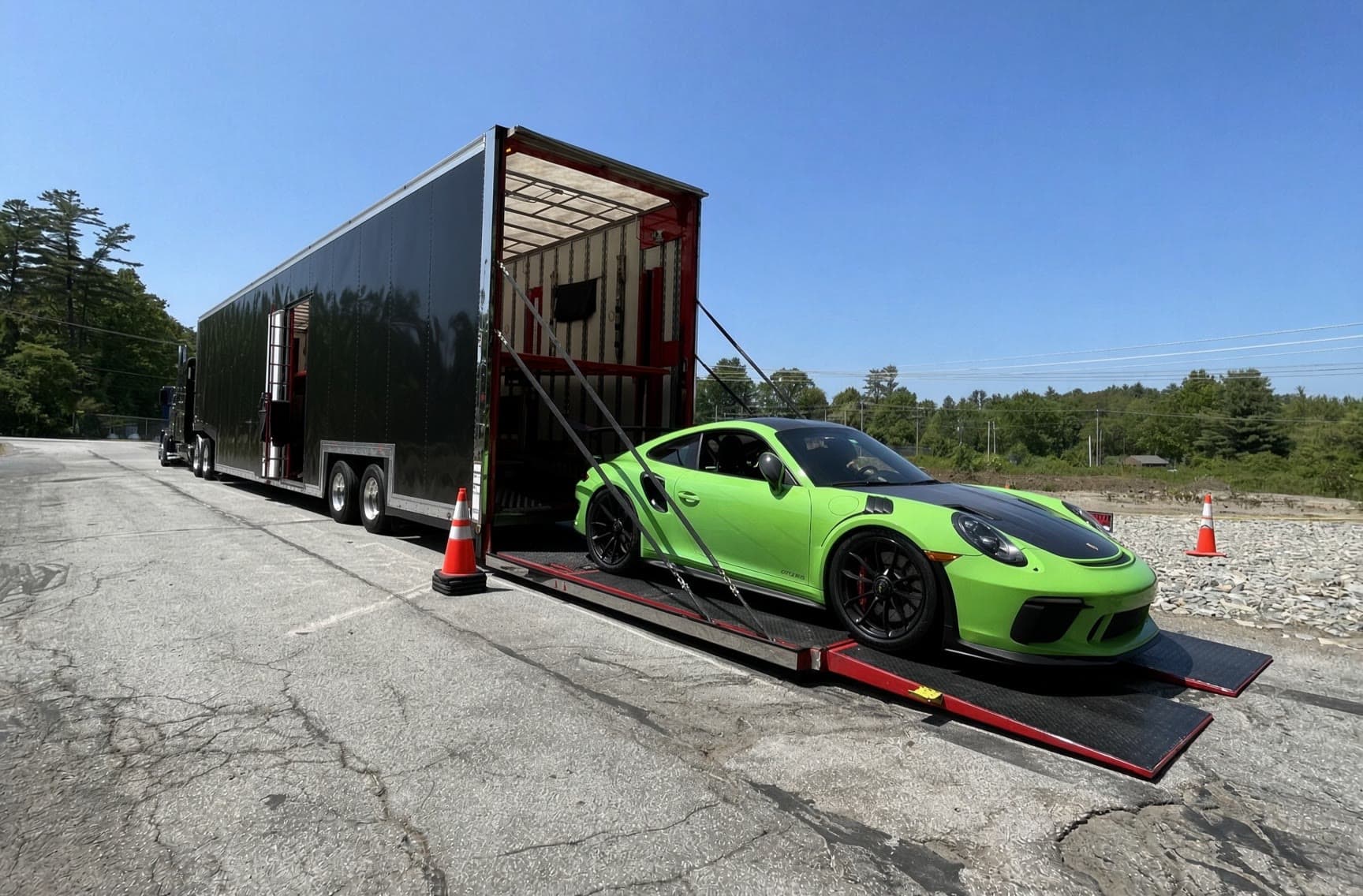
Enclosed auto transport is vehicle shipping inside a fully covered trailer, protecting the car from weather, road debris, and public view. Trailers carry 2 to 7 vehicles instead of 10, use soft straps and often hydraulic lift gates, and typically cost 40% to 60% more than open transport. It is the standard for classic, exotic, and high-value cars.
Enclosed equipment comes in a few forms and the difference matters more than most quotes admit. Soft-side enclosed uses a curtain or canvas wall — it blocks weather and debris but is the lightest-duty option. Hard-side single-level carries 2 to 4 cars in a straight rigid box and is common for high-end work. Hard-side multi-level with a lift gate is the top tier: 5 to 7 vehicles, a hydraulic gate instead of ramps, so a car with 3.5 inches of ground clearance loads flat without touching a splitter. Securement differs too — open haulers commonly chain to frame points, while quality enclosed carriers use soft nylon straps over the tires only, so nothing metal touches the vehicle.
Typical market pricing: enclosed on the New England-to-Florida lane commonly runs roughly $1,400 to $2,400 for a standard car, more for oversized or inoperable vehicles, with ranges shifting by season, vehicle, and route. The decision is not about how much you love the car — it is about replaceability of the finish. If a stone chip means a body shop touch-up you would rather not file a claim for, open is fine; if a stone chip means a repaint that destroys originality on a survivor car, enclosed pays for itself the first time.
Enclosed also buys discretion — a covered trailer at a dealership, an auction, or a residential street does not advertise what is inside, which matters for dealers moving high-line inventory out of ADESA Boston or Manheim New England. New England has a real enclosed use case beyond exotics too: winter. A car moving south in January on an open trailer meets road salt for 1,500 miles, which is an argument for enclosed on a freshly restored vehicle on its own.
The other common error is booking "enclosed" without asking what kind. Some brokers quote enclosed and dispatch soft-side equipment with ramps to a customer who has a 3-inch-clearance car and a six-figure valuation. Get three answers in writing before you pay: hard-side or soft-side, lift gate or ramps, and the per-vehicle cargo insurance limit. A carrier that owns the trailer can answer instantly; a broker has to go ask someone. If you have a car that should not see weather between New England and Florida, tell us the year, make, model, and ground clearance and get a quote.