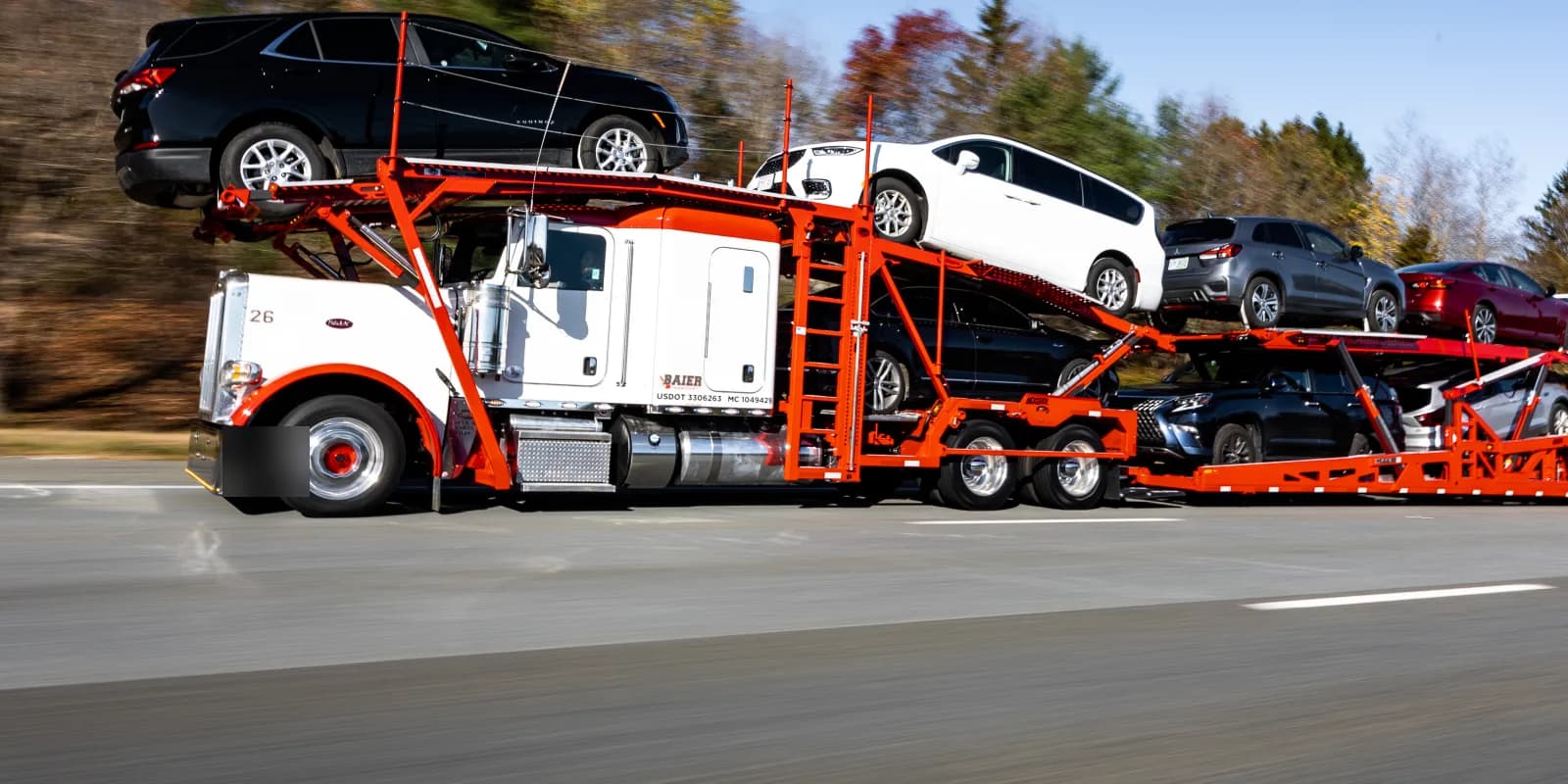
Door-to-door auto transport means the carrier picks up your vehicle at your address and delivers it to the destination address, rather than at a terminal or depot. In practice it means "as close as a 75-foot truck can legally and safely get" — sometimes your driveway, sometimes a nearby shopping center lot. It is the default service level for most shipments. A loaded multi-car carrier is roughly 75 to 80 feet long, 13.5 feet tall, and weighs up to 80,000 pounds, so it physically cannot enter most cul-de-sacs, gated communities with 90-degree turns, condo parking garages, or streets with low branches and parked cars on both sides.
The real sequence: the driver calls 12 to 24 hours ahead with an estimated arrival window, then again when close; if your street works, he comes to the house; if it does not, he asks you to meet at the nearest safe spot with room to load, typically a grocery store, big-box lot, or wide commercial street, usually within a mile or two; then inspection, Bill of Lading, keys, and load. None of that is an upcharge or a downgrade — it is the same service, the meeting point just moves.
Florida-specific reality: many snowbird destinations — Naples, Sarasota, Fort Myers, West Palm — are gated communities with guardhouses, narrow interior roads, and HOA rules against commercial trucks, so plan for a meet-up point and have the gate code or guard-list name ready if the truck can enter. Door-to-door genuinely fails in dense urban blocks like Boston's North End, Manhattan, and parts of Brooklyn, where a meet outside the neighborhood is required simply because a 75-foot rig cannot turn there.
Door-to-door removes two problems: getting your car to a terminal on the origin side and getting a ride from a terminal on the destination side. For a snowbird flying into RSW or Sarasota, that second problem is real — a rideshare from a terminal 40 miles inland can wipe out any savings from terminal service. It also compresses timelines, since a vehicle sitting at a terminal waiting for a truck adds days and a facility where nobody is personally accountable for it; direct door-to-door means the same driver signs for the car at both ends.
Because we run our own trucks on the New England to Florida corridor, our dispatcher knows which drivers are comfortable in tight Seacoast neighborhoods and which Florida communities require a meet — a load board carrier learns that when he arrives. The common mistake is assuming "door-to-door" guarantees the truck parks in your driveway, then treating a meet-up request as a bait-and-switch; it is not. The other mistake is not telling the carrier at booking that your street is narrow, gated, unpaved, or has a low overpass — a driver who discovers that at 6 a.m. loses an hour and may have to reschedule entirely. Tell us your pickup street and Florida destination and we will tell you honestly whether the truck fits or where we will meet you.