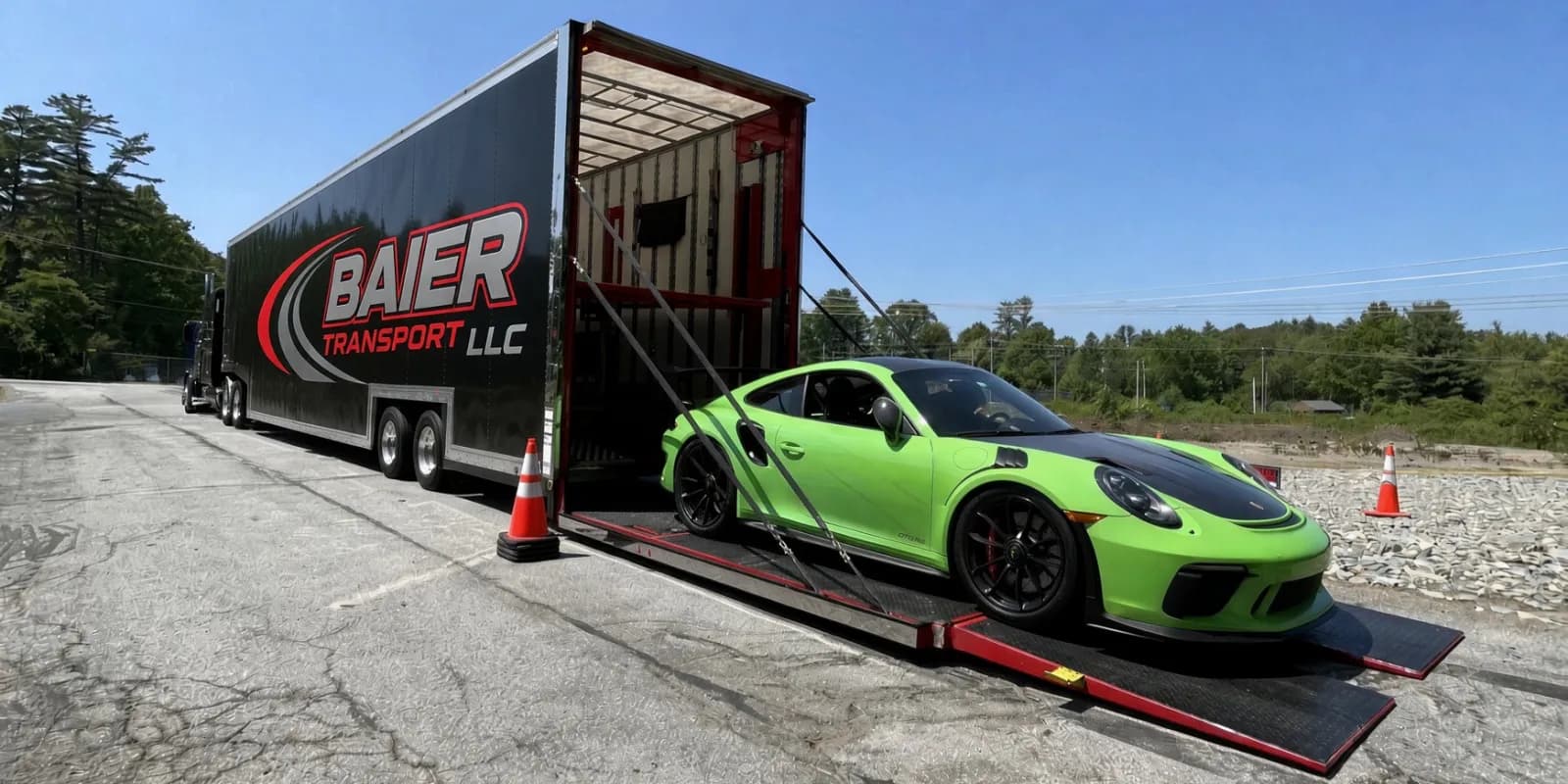
Luxury auto transport is not just enclosed transport with a nicer invoice. The things that actually protect a collector car are specific and checkable: soft-tie securement that never touches the chassis, a lift gate or low-angle ramps for anything under four inches of clearance, a photo-documented condition report before the doors close, and a cargo policy whose per-vehicle limit is bigger than what your car is worth.
If a company can't answer those four questions in one phone call, the trailer type doesn't matter.
We won't re-argue the open vs enclosed decision here — for a car in this category, enclosed is the starting point, not the conclusion. This post is about what separates a good enclosed haul from an expensive one.
Soft tie vs hard tie: the single most important question
There are two ways to strap a car to a trailer.
Hard tie (chassis tie-down) runs chains or ratchet straps from the trailer deck to the frame rails, subframe, control arms, or axles. It's fast, strong, and standard on open haulers. It also means the suspension is fully compressed for the entire trip, with metal hardware working within inches of underbody finishes.
Soft tie (wheel-net or over-the-tire securement) captures the tires themselves with nylon nets or basket straps. Nothing touches the frame, suspension, brake lines, or paint. The car sits on its own springs the way it does in a garage.
For a collector car, a restored car, a car with air suspension, or a car with a coated underbody, soft tie is the only acceptable answer. Ask it in exactly those words: "Do you soft tie, and can you send me a photo of a loaded car on your trailer?" An operator who does this daily will have the photo.
One detail for modern exotics: cars with adaptive or air suspension often have a transport or jacking mode, and some will fight a tie-down if the system is live. Tell the driver whether yours has one and how to set it.
Loading angle: the part that breaks bumpers
Standard open-hauler ramps sit at roughly 20 degrees. Anything under about four inches of ground clearance — a lowered car, most modern supercars, plenty of period race replicas — will contact a splitter, exhaust, or subframe on a 20-degree ramp.
The two solutions:
| Equipment | Effective loading angle | Best for |
|---|---|---|
| Hydraulic lift gate | 0° (car stays level) | Under 3.5 in. clearance, non-running, priceless |
| Extended aluminum ramps | 6° – 10° | 3.5 – 5 in. clearance, running |
| Standard ramps | ~20° | Above 5 in. clearance |
A hydraulic lift gate raises the car on a flat platform and sets it into the trailer without the car ever changing plane. If your car has ever needed a plank to get onto a driveway apron, this is the equipment you're paying for.
Measure the lowest point before you call — front splitter or exhaust, ground to bottom edge — and give the number. "It's pretty low" is not a spec.
Climate control: what it does and doesn't do
Some enclosed trailers are insulated and climate-moderated. The honest version of what that buys you:
It helps with fresh paint still gassing off, ceramic coatings inside their cure window, period-correct interiors with untreated leather or wool, and long winter runs where a steel trailer would otherwise swing 60 degrees between a Florida afternoon and a New Hampshire night.
It does not turn a trailer into a climate vault. A moderated trailer manages temperature swing and humidity; it is not a museum. If someone tells you climate control alone justifies a $900 premium on a driver-quality car, that's a sales line.
The bigger environmental factor in New England is salt. From January through March, the I-95 corridor northbound runs through several hundred miles of brine. Any enclosed trailer solves that.
Declared value, agreed value, and the certificate
This is where most collector-car shipments are actually exposed, and almost nobody explains it properly.
Three things are in play:
1. The carrier's cargo insurance. This is the coverage that responds if the carrier damages your car. It has a per-vehicle limit and a deductible. Ask for the certificate of insurance and read both numbers. Since March 2011, the FMCSA has not required most for-hire property carriers to file cargo insurance proof federally — federal rules mandate public liability coverage, generally $750,000 under 49 CFR 387.9, but cargo coverage is contractual. So "fully insured" is unverifiable until you see the document.
2. Declared value on the shipping contract. Some carriers ask you to declare a value, which can cap what's recoverable. Declaring $50,000 on a $180,000 car to save on a rate is a decision you'll regret exactly once. Declare accurately and get written confirmation the carrier's limit supports it.
3. Your own collector policy. Most specialty collector-car policies are written on an agreed value basis — a number set at underwriting, not depreciated at claim time — and many extend to the vehicle in transit. Call your agent before pickup and ask specifically whether transit by a commercial carrier is covered and whether it's primary or excess. Get the answer in writing.
We can't make legal or insurance guarantees on your behalf, and neither can anyone else quoting you. What we can do is hand you the certificate before pickup so you and your agent can look at real numbers. How claims, deductibles, and the vehicle inspection report fit together is covered in how auto transport insurance actually works.
What a proper condition report looks like
The vehicle inspection report attached to the bill of lading is the entire evidentiary record of your car's condition at pickup. For a collector car, a checkbox diagram is not enough. Insist on all of the following, at pickup and at delivery:
- Timestamped photos of all four corners, both sides, roof, hood, deck lid, and interior
- Close-ups of every existing flaw — stone chips, door dings, curb rash, glass pitting
- Odometer photo and VIN plate photo
- Wheel and tire condition, since wheel nets touch these directly
- Your own duplicate set, shot on your phone before the driver arrives
Do this yourself even if the carrier does it. It takes six minutes and it is the difference between a conversation and a dispute.
Prep checklist for a collector car
- Fuel to about a quarter tank — enough to load and unload, not enough to add unnecessary weight.
- Battery charged, tender removed and packed separately.
- Alarm disabled or the fob left with the driver, with instructions.
- Toll transponder removed. It will read on the highway from inside a trailer.
- Loose parts, spare wheels, and trim secured or shipped separately.
- No personal items in the car. They aren't covered by cargo insurance and they slide.
- Fluid leaks noted in writing. A dripping car may be refused or repositioned to the lower deck.
- A soft cover is fine inside an enclosed trailer; it is a liability on an open one.
Cost: what luxury auto transport runs
Typical 2026 market ranges for enclosed transport of a standard-footprint vehicle. Vehicles requiring a lift gate, single car transport, or a two-car trailer price above these.
| Lane | Miles | Enclosed, typical range |
|---|---|---|
| New Hampshire → Naples, FL | ~1,555 | $1,700 – $2,400 |
| Boston → Miami, FL | 1,489 | $1,600 – $2,300 |
| Boston → Sarasota, FL | 1,398 | $1,550 – $2,250 |
| New York → West Palm Beach, FL | ~1,250 | $1,450 – $2,100 |
| Northeast → 2,000+ mi (Scottsdale, Monterey) | 2,000 – 3,000 | $2,000 – $3,200 |
Add roughly $150 to $350 for lift gate handling, $250 to $500 for a winch load, and 25% to 60% for exclusive-use single car transport rather than a slot on a multi-car enclosed trailer. These are typical market ranges that vary by season, vehicle, and route — not quotes. Broader pricing logic is in what car shipping costs in 2026.
Why an owned fleet matters more here than anywhere else
On a daily driver, a broker finding you any decent carrier is a fine outcome. On a six-figure car, "any decent carrier" is not a plan.
Baier Transport LLC owns its trucks and employs its drivers out of Seabrook, New Hampshire. Jay Baier owns the company. We've moved 251,015+ vehicles, hold a BBB A+ rating, and run the ADESA Boston and Manheim New England auction lanes weekly — so our drivers have handled far more high-line inventory than a random truck pulled off a load board. Book with us and you can ask who is driving, see the trailer, and keep the same person on the phone from quote to delivery. A broker cannot tell you the driver's name, because they don't know it yet.
The Northeast collector calendar is real work for us: cars moving to and from events like the Audrain Newport Concours in Newport, Rhode Island each fall, buyers shipping purchases home to New Hampshire — where there is no state sales tax on a vehicle purchase — and collectors moving cars south for the Florida winter driving season. Lane detail is on our Florida route pages; equipment detail is on our enclosed auto transport service page.
Frequently Asked Questions
How much does it cost to ship a classic car? Enclosed transport from the Northeast to Florida typically runs $1,550 to $2,400 for a standard-footprint car, with coast-to-coast moves at $2,000 to $3,200. Add $150 to $350 for lift gate handling, $250 to $500 if the car doesn't run, and 25% to 60% for exclusive single-car service. These are typical market ranges that vary by season, vehicle, and route.
What is the difference between soft tie and hard tie? Hard tie secures the vehicle by chaining or strapping to the frame, subframe, or suspension, which keeps the suspension compressed for the whole trip. Soft tie captures the tires with nylon wheel nets so nothing touches the chassis or paint and the car rides on its own springs. For collector, restored, or air-suspension vehicles, soft tie is the correct method.
Does my classic car need a lift gate? If the lowest point of the car sits under about four inches from the ground, yes. Standard ramps load at roughly 20 degrees, which will contact a splitter or exhaust. Extended ramps get to 6 to 10 degrees and a hydraulic lift gate keeps the car level throughout. Measure the lowest point before booking and give the carrier the number.
Will my collector car insurance cover it during transport? Often, but you must confirm it. Most specialty collector policies are written on an agreed-value basis and many extend to transit by a commercial carrier — but coverage terms vary, and whether it is primary or excess to the carrier's cargo policy matters. Call your agent before pickup, ask specifically about commercial transit, and get the answer in writing.
How far in advance should I book enclosed transport for a collector car? Three to five weeks in normal conditions, and six or more if you're moving south during the October-to-November peak or shipping to a dated event. Enclosed trailers are far scarcer than open ones and do not scale up seasonally, so late requests can go unfilled at any price.
Can I ship a non-running classic car? Yes, with the right equipment. A car that rolls, steers, and brakes can be winched onto most enclosed trailers for roughly $250 to $500 extra. A car that does not roll or steer needs a lift gate or a flatbed transfer and should be disclosed at quote time. Never let a driver discover a non-runner at the curb.
Start with the VIN and the destination
Send us the VIN, the year, make, and model, the lowest ground clearance measurement, whether it runs, and where it's going. We'll tell you which of our trailers fits it, whether it needs the lift gate, what our cargo limit is, and what the run costs — before you commit to anything.
Start with the VIN and the destination, or reach a dispatcher directly through our contact page.
Ready to Ship Your Vehicle?
Free, no-obligation quote from Baier Transport. BBB A+ rated with over 251,015+ vehicles transported.
Or call (603) 490-7309