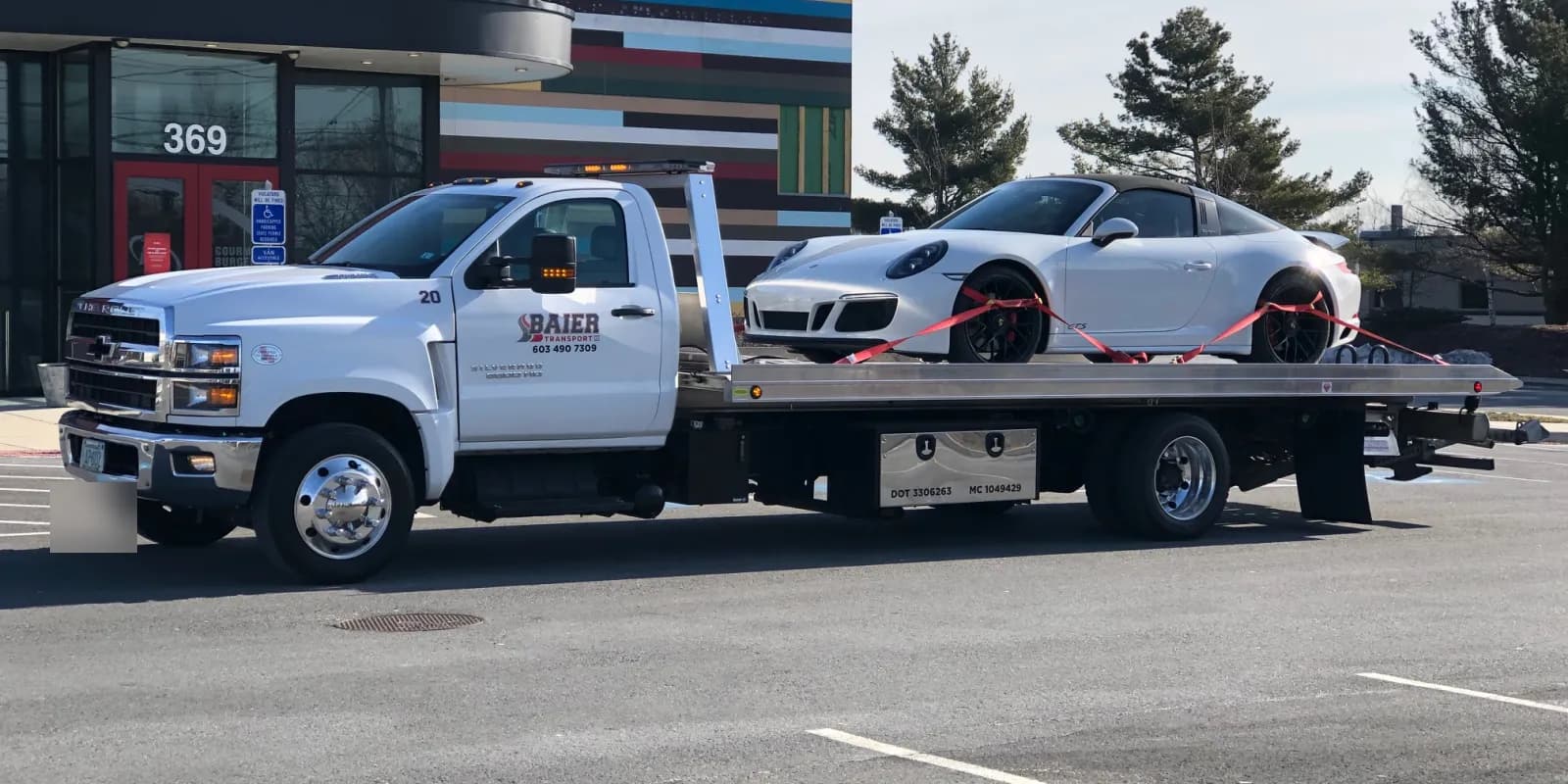
Door to door auto transport means the truck comes as close to your address as it can legally and safely get — which is your driveway on a wide suburban street, and a shopping-center parking lot two miles away if you live on a cul-de-sac with a 12-foot tree canopy. Terminal-to-terminal means you drop the car at a storage yard and pick it up at another yard near the destination.
Almost every carrier in the country now defaults to door-to-door, and roughly 90% of the time it works exactly the way you'd hope. The other 10% is the part nobody writes about honestly, so that's what most of this page covers: what a car hauler physically is, where it cannot go, and how a good dispatcher solves it before your pickup day instead of during it.
What a car hauler actually is
The confusion about door-to-door auto transport comes from people picturing a flatbed tow truck. That is not what shows up.
A standard open multi-car carrier is a tractor pulling a stinger-steered trailer. Federal rules require states to allow these units up to 75 feet in overall length on the National Network, plus a legal cargo overhang of 3 feet off the front and 4 feet off the rear — so a fully loaded 9-car rig can measure over 80 feet nose to tail. Width is capped at 102 inches. There is no federal height limit; states set their own, and most land between 13 feet 6 inches and 14 feet. Loaded, the whole unit runs up to 80,000 pounds.
Now picture that turning around in your neighborhood.
| Constraint | The number | What it means at your address |
|---|---|---|
| Overall length | 75 ft + overhang (~80 ft loaded) | Needs a straight run and a place to turn without backing blind |
| Width | 102 in (8.5 ft) | Two-way residential streets with parked cars on both sides get tight |
| Height | 13'6"–14' | Low branches, wires, parking-garage entries, some underpasses are out |
| Weight | Up to 80,000 lb | Soft shoulders, unpaved roads, weight-restricted bridges, private drives |
| Turning | No jackknifing in tight spots | Cul-de-sacs and dead ends usually require a meet |
None of this is the driver being difficult. A car hauler that gets wedged in a dead-end street with eight other people's vehicles on it is a genuinely bad afternoon for everyone.
When door-to-door means your actual door
It usually does. Good conditions for a driveway or curbside load:
- A two-lane or wider street the truck can drive straight through
- No low branches or utility lines under about 14 feet across the loading zone
- Enough curb length — roughly 100 feet of clear space to stage and load
- Paved surface with a firm shoulder
- No posted truck restrictions or weight limits on the approach
Suburban New Hampshire, most Massachusetts and Connecticut residential streets, and the majority of Florida developments outside gated communities all work fine.
When it means "the Publix parking lot on 41"
Here are the real-world situations where the truck won't reach your address, and what actually happens instead.
Gated communities and HOAs. This is the single most common one on the Florida end of the snowbird lane. Many Naples, Sarasota, Fort Myers, and West Palm associations prohibit commercial vehicles over a certain length inside the gates outright, and some only allow them during posted delivery windows on weekdays. Others let the truck in but have a guard-house canopy under 13 feet. The fix is simple if you plan it: call your association a week before pickup and ask two questions — is there a length or commercial-vehicle restriction, and is there a clearance at the entrance. Then tell your carrier the answer. We meet in a nearby plaza and it takes ten extra minutes.
Low-clearance canopies and covered entries. Hotel port-cocheres, condo garage entries, apartment complex breezeways, and hospital drop-off canopies are almost never tall enough. Meet at the far end of the outside lot.
Narrow historic streets. Portsmouth NH, Beacon Hill, downtown Newburyport, the older parts of Key West. Some of these blocks were laid out for horses. The driver will pick a nearby lot with an approach he can clear.
Cul-de-sacs and private dirt roads. A stinger-steered rig cannot swing a U-turn in a standard bulb. Rural dirt or gravel roads also carry a real risk of the drive axles sinking, especially after a New England thaw or a Florida rain week.
Winter conditions. In January in New Hampshire, an unplowed private drive is a no. Loading requires the driver to walk the rig and operate hydraulic ramps on stable, non-icy ground.
Local ordinances. Some towns prohibit commercial loading on residential streets, or restrict it by hour. Rare, but real.
In every one of those cases, the industry answer is a meeting point: a large, legal, well-lit lot with a straight in-and-out. Grocery stores, big-box retailers, Home Depots, and shopping plazas along a main road are the standard picks. You drive five to fifteen minutes, sign the bill of lading, and you're done.
The thing that separates a good carrier from a bad one is when you learn about the meeting point. It should be a phone call two or three days ahead from a dispatcher who knows the neighborhood — not a text from a driver who is already parked on Route 41 wondering where you are.
Terminal to terminal: what it is and who it's actually for
Terminal-to-terminal transport means you deliver your vehicle to a secured lot — a terminal — where it waits to be loaded, and you collect it from another lot at the far end.
It was the industry standard in the 1990s. It has mostly faded because door service got better and because terminals introduce two things customers dislike: storage fees and dwell time.
Where it still genuinely makes sense:
- You're flying out before the truck can come. Drop the car, get on the plane.
- You can't be present for pickup or delivery and have nobody local to hand keys to.
- Your address is a hard no — dense urban core with no legal loading option nearby.
- You want maximum schedule flexibility and minimum cost on a long, low-priority move.
Where it does not make sense: the Northeast-to-Florida snowbird run. You'd be driving to a yard on both ends, paying storage on at least one, and adding days of dwell — to save a modest amount on a lane where the trucks already come to your street. If that's your move, the timing question matters far more than the terminal question; see when to book for the season.
| Door to door | Terminal to terminal | |
|---|---|---|
| Where the car changes hands | Your address or a nearby lot | A secured storage yard |
| Typical extra cost | Included by most carriers | Sometimes $75–$150 less on the transport line |
| Storage fees | None | Often free for 1–3 days, then daily after |
| Total days | Shorter — no dwell | Longer — car may sit before and after |
| Your driving | 0–15 minutes if a meet is needed | Whatever it takes to reach both yards |
| Inspection quality | Done with you present, in daylight | Often done by yard staff without you |
| Best for | Nearly everyone, especially snowbirds | Flyers, unattended moves, dense urban addresses |
Those price differences are typical market ranges only. They move with season, vehicle, and route — see what car shipping actually costs for how the rest of the number is built. The only figure that means anything is a real quote on your actual lane.
That inspection row matters more than the money. Your vehicle inspection report is the document that establishes the car's condition at pickup. When you're standing there for it, you and the driver agree on every mark before the car goes up the ramp. When a yard attendant does it alone at 6 p.m. in November, you're relying on someone else's flashlight. If you ever need to make a claim, that matters — see how auto transport insurance works for what the paperwork has to prove.
How Baier handles the door part
We run our own trucks, so the person who decides where to meet you works in the same building as the person who answers your phone call. That is not a small thing. When a broker's driver hits a low canopy in Bonita Springs, the driver calls a dispatcher at a trucking company you've never spoken to, who calls the broker, who calls you.
Practically, on our door-to-door service:
- We ask about gate restrictions, clearance, and street width when you book — not on delivery day.
- If your address won't take an 80-foot rig, we name the meeting lot in advance and give you the driver's direct number.
- For tight Florida communities, we already know most of the standard meeting plazas on the Gulf coast. Our Southwest Florida deliveries run there every season.
- For very tight addresses, we can sometimes run a smaller unit — hotshot trucking style, a 3-car wedge that turns in far less space. It costs more per vehicle, but it exists.
Frequently Asked Questions
Does door to door auto transport mean the truck parks in my driveway? Sometimes, yes — if your street and driveway can take an 80-foot, 13.5-foot-tall, 80,000-pound rig. When they can't, the driver meets you at a nearby large parking lot, usually within a few miles. A good carrier tells you which it will be several days before pickup, not on the day.
Is terminal to terminal cheaper than door to door? Often modestly, but not always, and the savings frequently disappear into storage fees and your own driving. Typical market differences run under about $150 on the transport line, and vary by season, vehicle, and route. On the Northeast-to-Florida lane, door service is usually both faster and cheaper all-in.
What if my HOA doesn't allow car carriers inside the gate? That's common in Naples, Sarasota, Fort Myers, and West Palm. You meet the driver just outside the community in a plaza or wide shoulder. Call your association before pickup, ask about commercial-vehicle length limits and entrance clearance, and pass the answer to your carrier so it's planned, not improvised.
Do I have to be there for pickup and delivery? Someone over 18 does — to sign the bill of lading and walk the inspection with the driver. It doesn't have to be you. A neighbor, adult child, or property manager works fine, as long as you name them in advance and they have the keys.
Can the truck come to a condo or apartment building? Rarely to the building itself. Covered entries, parking decks, and interior loops almost never clear 13 feet 6 inches. Plan on the outer edge of the lot or an adjacent plaza. Buildings on wide commercial streets are usually fine at the curb.
Does door to door take longer than terminal to terminal? No — it's usually shorter. Terminal service adds dwell time on both ends while the car waits for a truck that fits the yard's schedule. Door service puts your vehicle on a truck that is already running your lane.
Get a real answer for your address
Tell us your pickup street and your Florida community name. We'll tell you before you book whether our truck comes to your door or where we'll meet you — and we'll put the driver's number in your hands. Get a quote or call and we'll pull up your address on the map while you're on the phone.
Ready to Ship Your Vehicle?
Free, no-obligation quote from Baier Transport. BBB A+ rated with over 251,015+ vehicles transported.
Or call (603) 490-7309